
Manufacturing businesses operate on some of the thinnest margins in any sector. Raw material costs fluctuate with commodity markets and exchange rates. Energy and logistics costs are largely outside the business’s control. Labour costs are rising. And the purchasing decisions that determine the cost of goods sold happen across procurement, operations, and maintenance simultaneously, often without a connected system giving finance a consolidated view.
Raw material prices increased an average of 5.4% during 2025, driven largely by tariffs and trade uncertainty. At the same time, 86% of manufacturers planned to pass at least some cost increases to customers, meaning the ability to control what is controllable on the cost side has become a direct competitive issue.
According to the National Association of Manufacturers’ Q4 2025 survey, only 69.9% of manufacturing executives said they are feeling positive about their company’s outlook, well below the historical average of 74%. Rising input costs, supply chain disruptions, and margin pressure are the defining operational challenges of the current environment.
For African manufacturers, these pressures are compounded by FX volatility on imported inputs, limited supplier alternatives on some raw material categories, and finance infrastructure that often lags behind the complexity of the procurement operation it is supposed to manage.
This guide covers the specific spend management challenges that manufacturing companies face and what connecting procurement, expense management, and vendor payments in a single system changes.
The Spend Management Challenges Specific to Manufacturing
Manufacturing spend is more complex than most other business types for three structural reasons: the volume of procurement decisions is high and recurring, the cost impact of each purchasing decision is directly tied to the cost of goods sold, and spending happens across multiple functions simultaneously with limited central visibility.
Raw material procurement is the highest-stakes spend category.
Every naira spent on raw materials feeds directly into the cost of a unit produced. A 2% overpayment on raw materials is a 2% reduction in gross margin on every product that uses those inputs. Yet in most manufacturing businesses, raw material purchasing is managed through a combination of standing orders, ad hoc vendor calls, and purchase orders that are not systematically checked against budget or contract terms.
Maintenance, repair, and operations spend is largely uncontrolled.
Many manufacturers spend inflationary periods reassessing where to reduce costs, such as renegotiating supplier contracts or auditing their supply chains. A significant share of that opportunity sits in maintenance, repair, and operations categories where purchasing is often reactive, uncontrolled, and managed by production staff without finance visibility. A machine breaks down. A technician orders a replacement part. The order is placed with whichever supplier can deliver fastest, at whatever price they quote. No approval. No budget check. No record in the system until the invoice arrives.
Multi-site operations fragment spend data.
A manufacturing business with production facilities in Lagos and Kaduna, a warehouse in Port Harcourt, and a head office in Abuja is managing spend across four locations with four different teams making purchasing decisions. Without a connected system, the consolidated spend position is only visible at month-end when data from all locations has been manually aggregated. In the meantime, each location is operating with its own budget view, its own vendor relationships, and its own interpretation of spending policy.
Capital expenditure requires more rigorous controls.
Manufacturing businesses make significant capital expenditure decisions on machinery, equipment, and facility upgrades that involve large sums, long lead times, and complex supplier negotiations. These decisions require multi-level approval, detailed documentation, and careful budget management. Capital expenditures in manufacturing rose approximately 3% in 2025, signaling continued investment in productivity and automation even amid uncertainty, making the governance of these decisions more important rather than less.
How Spend Management Addresses Manufacturing Cost Challenges
The following table shows how connected spend management addresses the specific cost challenges that manufacturing businesses face:
| Manufacturing Cost Challenge | Without Spend Management | With Connected Spend Management |
| Raw material procurement | Standing orders, no budget check, no contract compliance | Purchase approval with budget verification and three-way invoice matching |
| MRO spend | Reactive, uncontrolled, no finance visibility | Approval workflow for all purchases above threshold, real-time budget tracking |
| Multi-site spend visibility | Manual consolidation at month-end from multiple sources | Live dashboard showing spend across all sites in real time |
| Capital expenditure | Email approval chain, limited documentation, no committed spend tracking | Multi-level approval with full documentation, committed spend recorded on authorization |
| Supplier payment reliability | Manual payment initiation, delayed settlement, no delivery confirmation | Automated payment from approved invoice, real-time tracking, delivery confirmation |
| FX cost on imported inputs | Converted at point of payment at bank rates | Multi-currency wallet, conversion at favorable rates, full cost disclosed before confirmation |
Five Spend Management Priorities for Manufacturing Businesses
Priority 1: Connect raw material procurement to budget controls. Every raw material purchase request should route through an approval workflow that checks against the available budget on the relevant cost centre before authorization. The approval chain should be proportional to the order value: small repeat orders from approved suppliers can auto-approve, while large or new vendor orders require additional authorization.
Priority 2: Enforce vendor discipline on MRO categories. Maintenance, repair, and operations spend is the category where maverick purchasing is most common in manufacturing businesses, because urgency is used as a reason to bypass the formal procurement process. The solution is not slower approvals but faster formal ones: mobile approvals with escalation rules that route urgent requests to an available authorizer within minutes rather than days.
Priority 3: Create visibility across all production sites. A connected spend management system with entity-level budget configuration gives each site its own budget view and approval chain while giving group finance a consolidated view across all sites simultaneously. The spend data from Lagos and Kaduna arrives in the same format and maps to the same chart of accounts without manual consolidation.
Priority 4: Implement three-way matching on all supplier invoices. Fragmented data systems and inconsistent data classification create significant procurement compliance risks for manufacturers, particularly on high-volume recurring supplier relationships where invoice discrepancies can accumulate over time without detection. Three-way matching, comparing the purchase request, the delivery confirmation, and the vendor invoice before payment release, catches overbilling and contract non-compliance before funds move.
Priority 5: Manage FX costs on imported inputs. For African manufacturers sourcing raw materials or machinery internationally, FX costs on import payments are a controllable expense that most businesses do not actively manage. Holding foreign currency balances, converting at favorable rate windows rather than at the moment an invoice arrives, and using a platform that discloses the full FX cost before confirmation can meaningfully reduce the effective cost of imported inputs over a year.
How Duplo Works for Manufacturing Businesses
Duplo is built for African businesses that manage complex, high-volume spending across procurement, operations, and multiple locations.
Procurement approval workflows. Configure multi-level approval chains for raw material purchases, MRO orders, and capital expenditure by amount, category, and site. Auto-approve routine reorders from approved suppliers. Route non-standard purchases to the correct authorization level automatically.
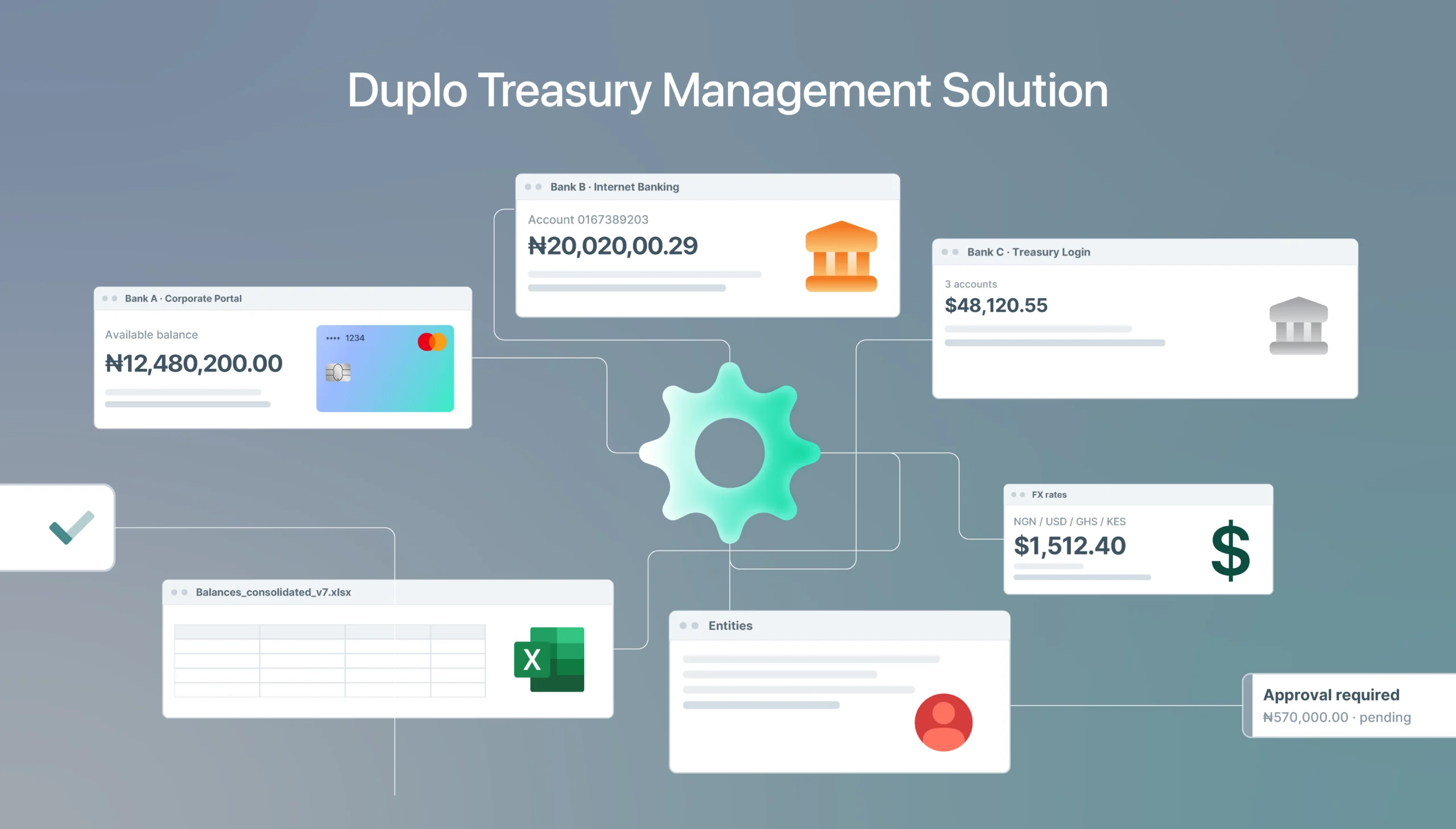
Multi-site budget management. Set separate budgets and approval chains for each production facility or entity. Finance at each site sees its own data. Group finance sees the consolidated position across all sites in real time.
Three-way invoice matching. Every vendor invoice matched automatically against the purchase request and delivery record before payment authorization. Mismatches flagged before funds move.
Vendor payment management. Pay domestic suppliers in NGN and international raw material suppliers in USD, EUR, or GBP from the same platform. Bulk payment runs for multiple vendors in a single execution. Real-time delivery confirmation.
Multi-currency wallets and Instant FX Swap. Hold USD, EUR, and GBP balances for international input purchases. Convert at competitive rates with full cost disclosed before confirmation. Reduce FX costs on imported raw materials and machinery.
Expense management for production and operations teams. Mobile receipt capture and fast submission for production staff and site managers. Approved expenses automatically reconciled against the relevant site budget.
Integrations with QuickBooks, Sage, and Xero. All spend data across all sites flows into your accounting system automatically. No manual consolidation. No month-end reconciliation backlog.
The Path Forward
Following a year of immense change, manufacturers will prioritize cost optimization in 2026 amid a fragmenting global economic picture. The manufacturers that succeed will be those that manage what is controllable on the cost side with discipline and data, while absorbing what is not controllable with operational resilience.
For African manufacturers, the controllable cost opportunity sits squarely in spend management: raw material procurement governance, MRO spend controls, multi-site visibility, and FX cost reduction on imported inputs. None of these require major capital investment. They require a connected system that gives finance visibility and control over the purchasing decisions that determine the cost of every unit produced.
? Duplo is built to provide that for African manufacturing businesses. Click here to get started.
Frequently Asked Questions
What is spend management for manufacturing companies? Spend management for manufacturing companies is the practice of controlling and optimizing all business spending, from raw material procurement and MRO purchases to vendor payments and capital expenditure, through a connected system that enforces budget controls, routes approvals automatically, and gives finance real-time visibility across all production sites and cost centres.
What are the biggest spend management challenges for manufacturers? The most significant challenges are: raw material procurement without systematic budget verification, uncontrolled MRO spend that bypasses formal approval processes, fragmented spend data across multiple production sites, capital expenditure without rigorous multi-level approval governance, and FX costs on imported inputs that are not actively managed.
How does spend management reduce manufacturing costs? Through four mechanisms: preventing maverick purchasing at premium rates by enforcing approved vendor lists and approval workflows; catching invoice discrepancies through three-way matching before payment; consolidating vendor spend to improve negotiating leverage; and reducing FX costs on imported raw materials through strategic currency management rather than reactive conversion at payment time.
Can Duplo handle spend management across multiple manufacturing sites? Yes. Duplo supports entity-level budget configuration and approval workflows for each production site, with consolidated group-level visibility across all sites simultaneously. Spend data from each site flows into a unified dashboard and directly into your accounting system without manual consolidation that supports better vendor negotiations and category management decisions.