
Every time a Nigerian business converts naira to dollars to pay a supplier, and then converts dollars back to naira when a customer pays, it absorbs two FX spreads on what is effectively a pass-through transaction. The naira went out as dollars. The dollars came back as naira. And somewhere between those two conversions, a margin was applied at each step that nobody disclosed as a separate charge.
For businesses that both import and export, or that pay overseas vendors while collecting from international customers, this conversion cycle is the single most avoidable cost in their payment operations. Multi-currency accounts save businesses an average of $40 to $100 per thousand dollars transferred, replacing slow, expensive wire transfers with instant, borderless financial management. The mechanism is straightforward: hold the currency you need, use it directly, and convert only what you must, when the rate works in your favor.
This guide covers what a multi-currency wallet is, why Nigerian businesses need one in 2026, what the CBN regulatory landscape means for your options, and what to look for when choosing one.
What a Multi-Currency Wallet Is and How It Works for Nigerian Businesses
A multi-currency wallet is a single account that holds balances in multiple foreign currencies simultaneously. Rather than maintaining separate bank accounts for USD, EUR, and GBP, your business holds all three in one place, alongside your naira balance, and moves between them as needed.
The practical capabilities a business multi-currency wallet should provide:
- Receive foreign currency payments from overseas customers directly into the relevant currency balance without auto-converting to naira on arrival.
- Hold USD, EUR, or GBP balances until conditions are favorable for conversion, rather than converting at whatever rate prevails the moment a payment lands.
- Send payments to overseas suppliers directly from your foreign currency balance without triggering a naira conversion on every transaction.
- Convert between currencies at competitive rates at the timing of your choice, with the full cost disclosed before you confirm.
Cross-border B2B transactions are projected to exceed $42.7 trillion in 2026, driving a 25% surge in business adoption of multi-currency accounts as companies look to slash foreign exchange costs and bypass legacy banking constraints. Nigerian businesses that do not have access to this infrastructure are absorbing costs that their international competitors are not.
Why Domiciliary Accounts Are No Longer Enough in 2026
The traditional solution for Nigerian businesses needing to hold foreign currency has been the domiciliary account. But the domiciliary account landscape changed significantly in May 2026.
On May 1, 2026, a new CBN directive came into full effect, requiring all International Money Transfer Operators to route transactions through designated naira settlement accounts. Recipients now receive naira, not dollars, regardless of whether they hold a domiciliary account. The scale of this shift is massive. Nigeria received approximately $20.93 billion in personal remittance inflows in 2024, and this directive fundamentally changes how foreign currency enters the Nigerian financial system.
Beyond the regulatory change, domiciliary accounts have always carried structural limitations that make them difficult to use for active business payment management:
- Branch visits required for setup at most banks, with lengthy documentation processes.
- Limited digital access that makes initiating outbound transfers cumbersome.
- No integration with payment workflows, approval processes, or accounting systems.
- No real-time visibility into balances across multiple currencies from a single dashboard.
- Outbound transfers still route through the correspondent banking system, carrying the same multi-day settlement timelines and hidden FX margins as regular bank wire transfers.
Domiciliary accounts are failing Nigerian businesses that need to actively manage foreign currency balances for trade and vendor payments, not just hold dollars passively. The requirement for active foreign currency management in a Nigerian business context has outgrown what a traditional domiciliary account was designed to deliver.
The Businesses That Benefit Most From a Multi-Currency Wallet in Nigeria
Not every Nigerian business has the same foreign currency exposure. The following business types have the most to gain from a properly structured multi-currency wallet:
Importers. Businesses that source raw materials, finished goods, or equipment from overseas suppliers pay in USD or EUR regularly. Every naira-to-dollar conversion on each invoice is an FX cost. Holding a USD balance and paying suppliers directly eliminates the conversion cost entirely on outbound payments.
Exporters. Businesses that sell goods or services to international buyers receive USD, EUR, or GBP. Converting immediately on receipt at whatever rate prevails that day is the most expensive way to manage those inflows. Holding export receipts and converting when the rate is favorable, or deploying them directly for USD-denominated expenses, generates meaningful savings.
Businesses with both import and export flows. This is where the multi-currency wallet delivers its highest value. A manufacturer that receives USD from export customers and pays USD to import suppliers has a natural offset. If both flows run through the same USD wallet, the conversion cost on both legs drops to near zero. The wallet holds USD in, deploys USD out, and naira conversion only happens on the net position.
Businesses paying for international SaaS, tools, or services. Nigerian businesses paying for software subscriptions, advertising platforms, cloud services, or international contractors in USD or EUR absorb a conversion cost on every recurring charge. A funded USD wallet eliminates this for the entire category.
What to Look for in a Multi-Currency Wallet for Your Nigerian Business
Not all multi-currency accounts solve the same problem. Some focus only on receiving international payments, while others come with features such as holding balances, managing supplier payments, integrating marketplace collections, or accessing virtual cards. The right choice depends on which of these capabilities your business actually needs.
The criteria that matter most for Nigerian businesses evaluating a multi-currency wallet:
Currency coverage. USD, EUR, and GBP are the minimum. Look for a platform that supports the specific currencies your business actually deals in, not just the most common ones globally.
Receive, hold, and send capability. Some platforms only support receiving. Others support receiving and holding but require you to go back through a bank to send outbound payments. A genuine multi-currency wallet lets you do all three from the same balance.
FX transparency. The platform should show the exchange rate and the FX spread as separate figures before you confirm any conversion. If the spread is buried in the rate, you are absorbing an undisclosed cost on every conversion.
Payment workflow integration. A multi-currency balance that is disconnected from your payment approval and reconciliation workflow creates a new administrative layer rather than removing one. Look for a platform where your multi-currency wallet connects to your bulk payments, vendor payments, and accounting integrations in the same system.
Regulatory compliance. Any platform holding foreign currency on behalf of a Nigerian business must be appropriately licensed. For Nigerian businesses, confirm CBN licensing, PCI DSS certification, and NDPC registration before depositing business funds.
How Duplo’s Multi-Currency Wallets Work for Nigerian Businesses
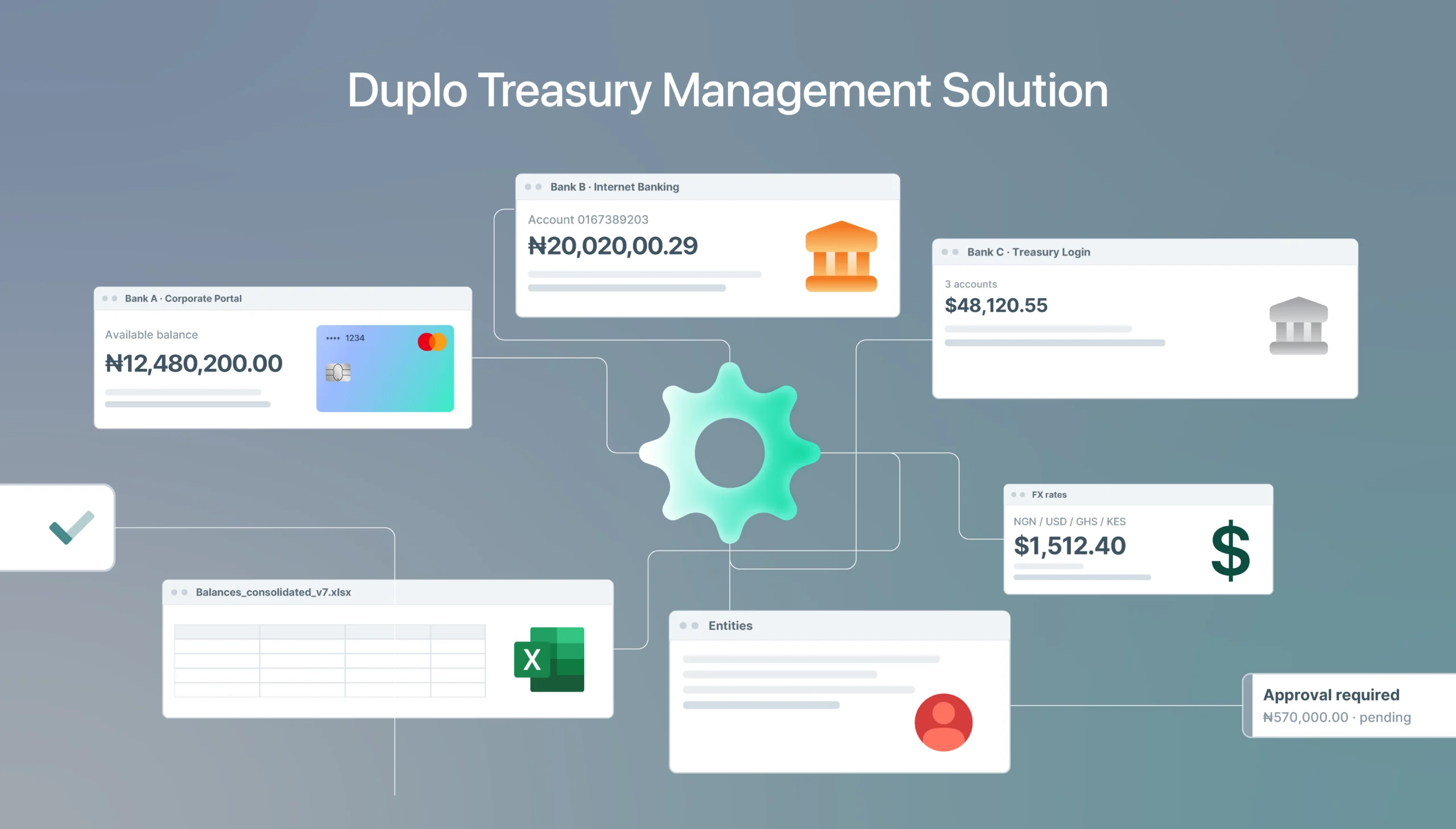
Duplo gives Nigerian businesses a single wallet that holds NGN, USD, EUR, and GBP simultaneously, connected to the same platform that handles their vendor payments, bulk payments, expense management, and auto reconciliation.
Receive international payments directly. Get paid by overseas customers into your USD, EUR, or GBP balance without immediate naira conversion. The currency arrives and stays in the currency it came in until you decide what to do with it.
Pay overseas suppliers from your foreign currency balance. Send international payments to 160+ countries in 80+ currencies directly from the relevant wallet balance. No naira conversion required when the balance and the payment currency match.
Convert with Instant FX Swap at competitive rates. When you do need to convert, Duplo’s Instant FX Swap shows the exchange rate and the full cost before you confirm. You choose the timing. You see the spread. No surprises on your statement.
One dashboard for all your currency balances. See your NGN, USD, EUR, and GBP positions simultaneously, alongside your payment activity, approvals, and reconciliation records. No logging into separate accounts for each currency.
Connected to your entire payment workflow. Your multi-currency balances connect directly to Duplo’s bulk payments, vendor payment management, approval workflows, and auto reconciliation. Foreign currency payments are approved, executed, and reconciled within the same system as every other payment your business makes.
How Duplo Handles Bulk Payments for Nigerian Businesses
Nigerian businesses using Duplo’s bulk payment capability do not log into multiple bank portals, process transfers one at a time, or reconstruct approval records after the fact. Here is what the process looks like instead.
Pay up to 500 recipients in a single run. Upload a CSV file or trigger payments via API. Every entry is validated before execution. Duplicate account numbers, missing fields, and policy violations are flagged before a single payment is processed.
Approval workflows built in. Every bulk payment batch routes through your configured approval chain automatically. Approvers review the full batch on mobile or desktop and confirm or reject with a full audit trail created at every step.
Real-time tracking on every payment in the batch. See the status of each recipient payment as it processes, not just a batch-level summary. Know exactly which payments have cleared and which need attention before your vendor calls to ask.
Auto reconciliation. Every payment in the batch is automatically matched to its corresponding vendor record and posted to your accounting system. No manual matching. No month-end spreadsheet exercise. Just clean books.
Pay locally and internationally in one run. Domestic NGN payments and international transfers in USD, EUR, and GBP can be processed in the same bulk payment batch. One run. One approval. One reconciliation file.
The Path Forward
The naira-to-dollar-to-naira conversion cycle that most Nigerian businesses run on every international transaction is not a fixed cost of doing business. It is a structural inefficiency that persists because the infrastructure to eliminate it has not been widely adopted, not because it cannot be eliminated.
Businesses that hold foreign currency balances, deploy them directly for same-currency payments, and convert only the net position are not doing anything special. They are using the same tools that businesses in more developed markets have taken for granted for years. Those tools are now available to Nigerian businesses through CBN-compliant platforms that hold the appropriate licenses and regulatory credentials.
The FX cost your business absorbed on its last ten international transactions was largely avoidable. The ones that follow do not have to be.
👉 Click here to speak with a member of our team today.
Frequently Asked Questions
What is a multi-currency wallet for Nigerian businesses?
A multi-currency wallet is a single account that holds balances in multiple foreign currencies, such as USD, EUR, and GBP, alongside naira, from one platform. It allows Nigerian businesses to receive international payments, hold foreign currency balances, pay overseas suppliers directly, and convert between currencies at the timing and rate of their choice, without maintaining separate bank accounts for each currency.
Is it legal for Nigerian businesses to hold foreign currency in a multi-currency wallet?
Yes, provided the platform holding the currency is appropriately licensed. For Nigerian businesses, confirm that the platform holds CBN licensing for payment services. Duplo is CBN-licensed, PCI DSS certified, ISO certified, NRS SI and APP licensed, and NDPC-registered.
How is a multi-currency wallet different from a domiciliary account?
A domiciliary account is a bank account denominated in a foreign currency, typically requiring branch setup and offering limited digital functionality. A business multi-currency wallet holds multiple currencies simultaneously from a single digital platform, with integrated payment capabilities, real-time FX conversion, and direct connection to payment workflows and accounting systems. The two serve different operational needs.
How does holding USD in a multi-currency wallet save my business money?
By eliminating unnecessary conversion cycles. If your business receives USD from export customers and pays USD to import suppliers, running both flows through a USD wallet removes two FX conversion costs per cycle. You only convert the net naira position, reducing your total FX cost significantly compared to converting on every individual inbound and outbound transaction.
Can I use a multi-currency wallet to pay international suppliers from Nigeria?
Yes. Duplo’s multi-currency wallet connects directly to international payment capabilities, allowing you to send payments to overseas suppliers in 160+ countries and 80+ currencies directly from your foreign currency balance, without triggering a naira conversion on each transaction.