Picture the last time your finance team ran a payment cycle. Someone pulled up a spreadsheet with vendor names, account numbers, and amounts. Someone else logged into the bank portal. The portal had a session timeout. They logged back in. Each transfer was initiated individually. Some banks have a limit on how many transactions you can process in a day. The team came back the next morning to finish the rest.
By the time the payment run was complete, half a day was gone. The vendors who received payment early had no idea it was coming. The ones who had not received payment yet were already calling to follow up.
This is the standard vendor payment experience for most Nigerian businesses. It is not a process problem. It is an infrastructure problem. And it has a direct solution: bulk payments software.
What Bulk Payments Actually Are and Why They Matter for Nigerian Businesses
A bulk payment is a single instruction that initiates multiple individual payments simultaneously. Instead of logging into a bank portal and processing one transfer at a time, you upload a file containing all your payment instructions, and the system processes every one of them in a single run.
Businesses operating across Nigeria deal with fragmented banking infrastructure, multiple currencies, varied payment method preferences, and regulatory complexity that multiplies with each new market. Different banks, currency conversion requirements, and varying KYC standards turn what should be simple vendor payments into administrative nightmares.
For a business with 50 vendors, processing payments individually takes hours. For a business with 200 vendors across multiple banks and payment channels, it takes days. Bulk payments compress that entire cycle into minutes.
Digital payment platforms currently process almost double the yearly transactions of traditional banks. E-payment transactions hit a record NGN 1.07 quadrillion in 2025, a 79% year-on-year increase. Nigerian businesses are moving more money digitally than ever before, but most are still initiating that money movement one transfer at a time.
The Hidden Cost of Processing Vendor Payments One at a Time
The time cost of manual vendor payment processing is the most visible problem, but it is not the only one. Processing payments individually across multiple bank portals creates several compounding operational risks that most businesses have normalized without calculating.
Errors multiply with volume. Every manual data entry is an opportunity for a mistake. A transposed digit in an account number sends a payment to the wrong recipient. An incorrect amount overpays a vendor. A missed entry means a supplier does not get paid at all. The more payments you process manually, the more errors you introduce, and reconciling those errors after the fact takes as long as the original payment run.
Approval trails disappear. When payment instructions move through WhatsApp messages, email threads, and verbal confirmations, there is no reliable record of who authorized what and when. Finance teams that face an audit or a vendor dispute have to reconstruct approval records from message histories and bank statements, a process that takes days and still produces incomplete documentation.
Vendor relationships suffer. Suppliers who receive payments inconsistently- sometimes on time, sometimes late, sometimes without reference data that matches their invoice, adjust their behavior accordingly. They tighten terms, require advance payment, and deprioritize your orders when capacity is constrained. The commercial cost of payment unreliability shows up in the terms you are offered, not just in the time your team spends processing.
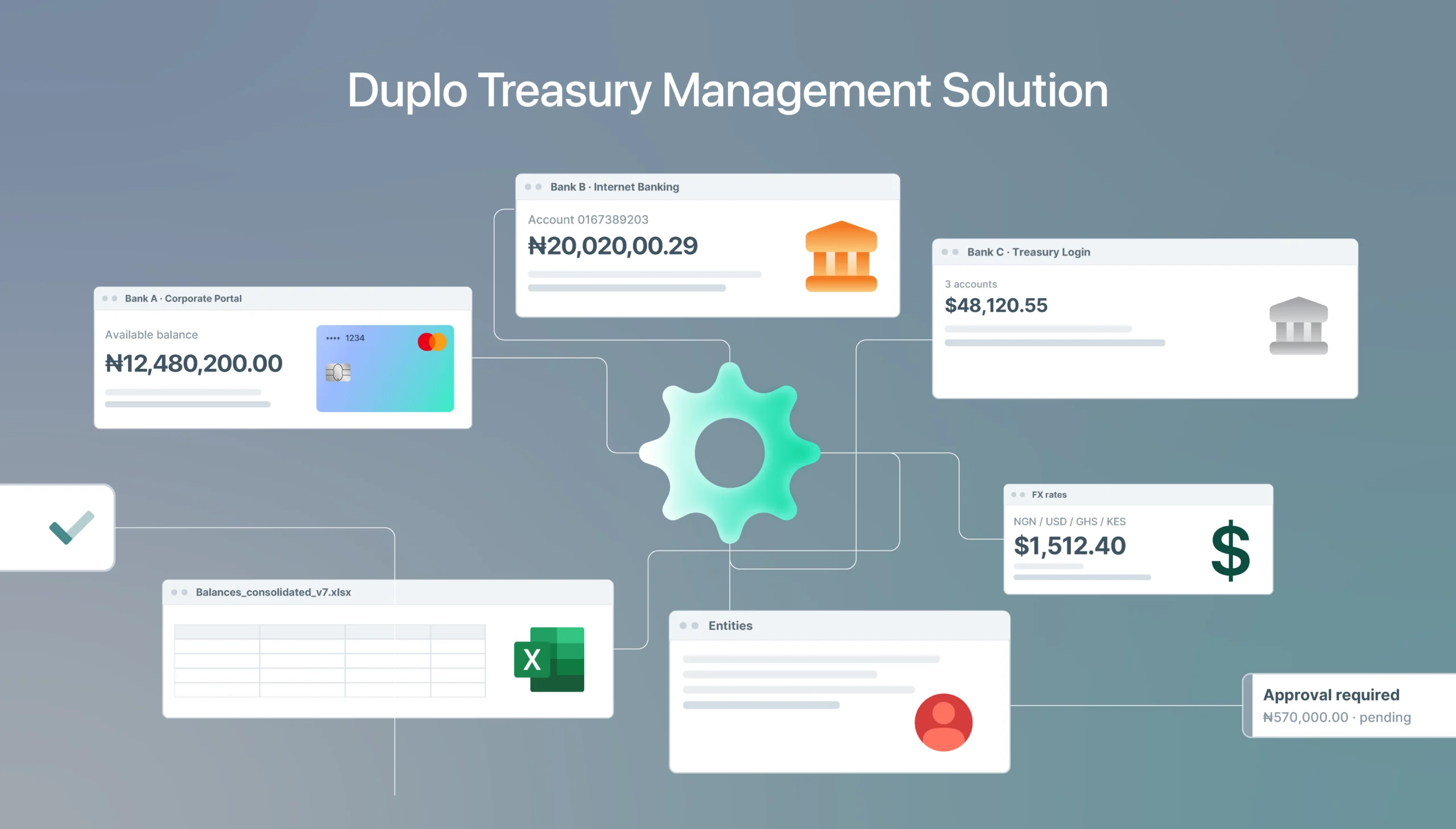
Cash flow visibility breaks down. When payments are processed across multiple bank portals on different days by different team members, no single person has a complete, current picture of what has gone out, what is pending, and what the true cash position of the business is. Finance leaders make decisions on incomplete data.
How Bulk Payments Work in Practice
A well-implemented bulk payment process follows a simple three-step flow that replaces the manual portal-by-portal approach entirely.
Step 1: Prepare your payment file.
Compile all payment instructions into a structured format, typically a CSV file with vendor name, bank account number, bank name, amount, and payment reference. Most bulk payment platforms provide a template that ensures the data is formatted correctly before upload.
Step 2: Upload, review, and approve.
Upload the file to your bulk payment platform like Duplo. The system validates each entry, flagging duplicate account numbers, missing fields, or amounts that exceed configured limits, before you confirm. An authorized approver reviews the batch and confirms. The entire review process takes minutes rather than the hours consumed by individual portal logins.
Step 3: The platform executes.
Once approved, the platform processes every payment in the batch simultaneously. Each vendor receives their payment with the correct reference data. You receive a confirmation record showing every successful payment, every failed transaction, and the reason for any failure.
A vendor payout is a payment you owe a supplier, contractor, or partner for work already delivered. A mass payout is the mechanism that pays hundreds of them at once. You run vendor payouts through a bulk batch, which is why the two terms get used as if they were one thing.
What to Look for in a Bulk Payment Solution for Nigerian Businesses
Not all bulk payment platforms are built equally for the Nigerian operating environment. Before choosing one, evaluate it against these criteria:
File format flexibility. The platform should accept CSV uploads and support API-triggered bulk payments for businesses that want to automate the process entirely rather than uploading files manually.
Validation before execution. A good bulk payment platform catches errors before money moves, not after. Look for duplicate detection, account number validation, and policy limit checks built into the pre-submission review.
Approval workflow integration. Bulk payments should not bypass your authorization structure just because they are processed in a batch. The platform should route bulk payment requests through the same approval chain as individual payments, with the full batch visible to the approver before confirmation.
Real-time tracking per recipient. After a batch is processed, you should be able to see the status of every individual payment in the batch, confirmed, pending, or failed, not just a single batch-level status update.
Reconciliation output. Every completed bulk payment run should produce a reconciliation file that maps each payment to its corresponding invoice or vendor record, ready to import into your accounting system without manual data entry.
How Duplo Handles Bulk Payments for Nigerian Businesses
Nigerian businesses using Duplo’s bulk payment capability do not log into multiple bank portals, process transfers one at a time, or reconstruct approval records after the fact. Here is what the process looks like instead.
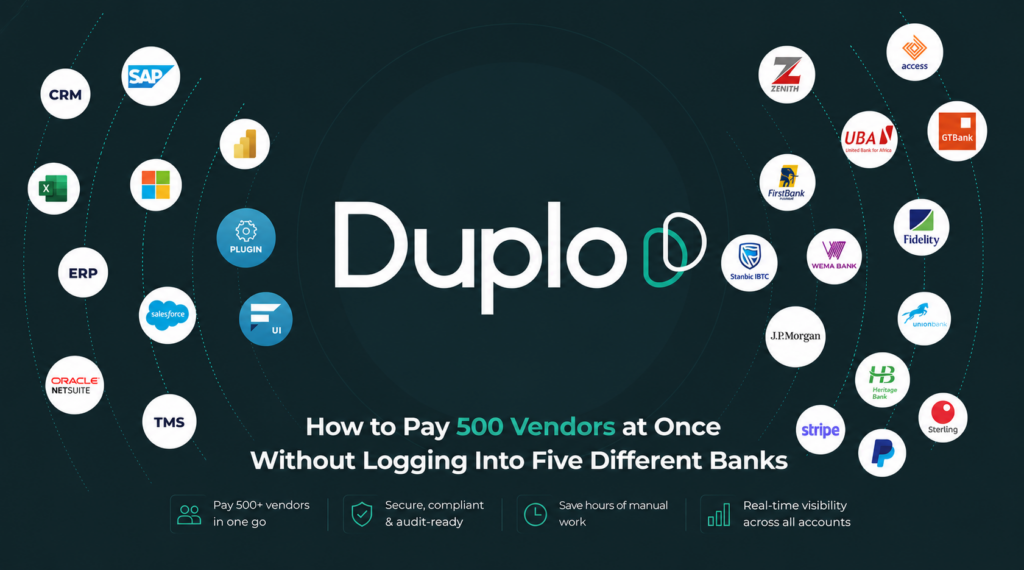
Pay up to 500 recipients in a single run. Upload a CSV file or trigger payments via API. Every entry is validated before execution. Duplicate account numbers, missing fields, and policy violations are flagged before a single payment is processed.
Approval workflows built in. Every bulk payment batch routes through your configured approval chain automatically. Approvers review the full batch on mobile or desktop and confirm or reject with a full audit trail created at every step.
Real-time tracking on every payment in the batch. See the status of each recipient payment as it processes, not just a batch-level summary. Know exactly which payments have cleared and which need attention before your vendor calls to ask.
Auto reconciliation. Every payment in the batch is automatically matched to its corresponding vendor record and posted to your accounting system. No manual matching. No month-end spreadsheet exercise. Just clean books.
Pay locally and internationally in one run. Domestic NGN payments and international transfers in USD, EUR, and GBP can be processed in the same bulk payment batch. One run. One approval. One reconciliation file.
The Path Forward
The vendor payment process that most Nigerian businesses are running today was designed for a team of ten. It breaks at fifty and becomes a liability at one hundred. Every manual portal login, every individually initiated transfer, and every end-of-month reconciliation exercise that takes days instead of hours is a cost that scales with the business rather than staying fixed.
Bulk payments do not just save time on a single payment run. They change the operational baseline for everything that follows: faster supplier settlement, cleaner reconciliation, better audit trails, and the payment reliability that earns better commercial terms from vendors over time. The businesses that have made this shift are not managing payment runs differently. They are managing them at a fundamentally different level of efficiency.
👉 The infrastructure to make that shift is available today. If your business is still processing vendor payments one at a time, click here to book a demo with a member of our team!
Frequently Asked Questions
What is a bulk payment solution?
A bulk payment solution is a platform that allows businesses to initiate multiple payments simultaneously from a single instruction, rather than processing each transfer individually through a bank portal. It is used to pay vendors, suppliers, contractors, salaries, and any other recurring payment obligations efficiently and at scale.
How many vendors can I pay at once with a bulk payment platform?
It depends on the platform. Duplo supports bulk payments to up to 500 recipients in a single run, covering both domestic NGN payments and international transfers in USD, EUR, and GBP.
Is bulk payment safe for Nigerian businesses?
Yes, provided the platform is CBN-licensed and holds the appropriate regulatory credentials. Duplo is CBN-licensed, PCI DSS certified, ISO certified, NRS SI and APP licensed, and NDPC-registered. Every bulk payment run goes through validation, approval workflows, and compliance screening before funds move.
How do I set up bulk payments for my Nigerian business?
The simplest approach is to prepare a CSV file with your vendor payment details, upload it to a bulk payment platform like Duplo, route it through your approval workflow, and confirm. The platform handles execution, tracking, and reconciliation from there.
What happens if one payment in a bulk batch fails?
On Duplo, failed payments in a batch are flagged individually with the specific reason for failure. Successful payments in the same batch are not affected. You can review, correct, and reprocess failed entries without rerunning the entire batch.