
Nigeria’s FMCG sector is navigating one of its most complex operating environments in recent years. Combined profit among Nigeria’s ten leading consumer goods companies rose to N307.5 billion in Q1 2026, a 19.6% increase from the same quarter in 2025. But revenues remained largely flat, increasing only marginally from N1.76 trillion to N1.78 trillion despite widespread price increases, meaning margin improvement is coming from cost discipline rather than top-line growth.
FMCG companies in Nigeria face a double squeeze: rising import costs driven by naira volatility and the inability to fully pass those costs to consumers whose purchasing power has weakened significantly. Several major players have responded by shifting toward local sourcing, portfolio pruning, and debt restructuring.
For FMCG manufacturers, distributors, and distribution companies operating in Nigeria, the businesses that protect their margins in this environment are those that manage costs with precision on every controllable dimension: supplier payments, field sales expenses, distribution fleet costs, and the FX burden on imported raw materials and inputs.
This guide covers the specific spend management challenges that Nigerian FMCG and distribution companies face and what a connected system changes.
The Spend Management Challenges Specific to Nigerian FMCG and Distribution
High-volume supplier payments with tight working capital.
FMCG distribution in Nigeria operates on thin margins and fast inventory turnover. Payment terms with principal suppliers are often short: some require payment before release of goods, others offer 7 to 30-day terms that leave little room for payment delays. Trade receivables across Nigeria’s leading FMCG companies surged to N515.3 billion in Q1 2026 from N423.4 billion in the same period of 2025, indicating that a growing portion of sales is being made on credit rather than immediate cash, putting additional pressure on the working capital position of distributors in the chain.
For distribution companies, the working capital pressure translates directly into spend management pressure: supplier payments must be executed accurately and on time to maintain supply allocation, while incoming payments from retailers are increasingly delayed by credit terms.
FX costs on imported raw materials and inputs.
Nigeria imports over USD 10 billion worth of food annually, and FMCG companies face elevated costs on imported inputs as the naira exchange rate stabilizes but FX shortages persist. In 2025, Nestlé Nigeria prioritized paying off USD 20 million of inter-company foreign debt early to limit risk from further currency depreciation, while Cadbury Nigeria swapped USD 7.7 million of debt with parent company Mondelez in return for equities
For FMCG manufacturers sourcing imported ingredients, packaging, or equipment, the FX cost on every purchase is a directly controllable expense that most businesses have not actively optimized. Banks apply FX margins above the interbank rate without disclosure. A manufacturer making ten USD-denominated supplier payments per month is absorbing that margin ten times, with no systematic way to reduce it unless they actively manage their FX strategy.
Field sales expense management across a distributed workforce.
Nigerian FMCG distribution relies heavily on field sales representatives, van sales operators, and trade marketing teams operating across multiple states simultaneously. These teams incur daily expenses: fuel, accommodation for out-of-Lagos routes, market activation costs, and trade promotions funded at the point of sale.
Without structured mobile expense capture and approval, field sales expenses are managed through cash advances that are reconciled weeks later, often with missing receipts, inconsistent categorization, and limited ability to track costs against specific routes, territories, or campaigns.
Multi-depot spend visibility without centralized control.
A distribution company with depots in Lagos, Ibadan, Kano, and Port Harcourt is managing spending across four locations simultaneously. Each depot incurs operational expenses, fleet maintenance costs, and local vendor payments. Without a connected spend management system, the consolidated cost picture is only visible at month-end when data from all depots has been manually aggregated, by which time it is too late to intervene on overruns that have already occurred.
How Spend Management Addresses Nigerian FMCG and Distribution Cost Challenges
| Cost Challenge | Current State | Spend Management Solution |
| Supplier payment volume | Manual processing; delayed payments risk supply allocation | Bulk payment runs; automated approval workflows; same-day settlement |
| FX costs on imported inputs | Converted at bank rate on each transaction; margin undisclosed | Multi-currency wallet; Instant FX Swap at competitive rates; full cost disclosed |
| Field sales expense leakage | Cash advances; informal reconciliation; receipts lost | Mobile receipt capture; job code assignment; automated approval routing |
| Multi-depot visibility | Manual consolidation at month-end | Live dashboard across all depots in real time |
| Trade promotion spend control | Informal authorization; no budget tracking by campaign | Campaign-level budget configuration; approval workflow with spend limits |
| Duplicate supplier payments | Same invoice processed twice in disconnected systems | Automated duplicate detection before payment release |
Five Spend Management Priorities for Nigerian FMCG and Distribution Companies
Priority 1: Automate high-volume supplier payment cycles.
FMCG distributors make payments to dozens of suppliers on recurring cycles. Processing these individually, each with manual authorization and bank transfer initiation, creates processing overhead that grows with the business and introduces delays that damage supplier standing. Bulk payment capability, paying up to 500 suppliers in a single run with automated matching to purchase orders, reduces both the processing time and the risk of payment errors on high-volume cycles.
Priority 2: Manage FX costs on imported FMCG inputs strategically.
FMCG firms in Nigeria have increased capital expenditure to N476.76 billion in 2025, the highest level in five years, driven by ongoing investments in operational efficiency, asset replacement, and supply chain improvements. A significant share of that investment is dollar-denominated, making FX cost management a direct determinant of project ROI.
Rather than converting naira to USD reactively when each import invoice arrives, FMCG companies that hold USD balances in multi-currency accounts and deploy them directly for USD-denominated payments reduce the number of conversion events and gain the ability to time conversions at favorable rate windows.
Priority 3: Digitize field sales expense management.
Replace cash advance reconciliation for field sales teams with mobile expense capture that requires a receipt photo, territory or route code, and campaign reference at the point of purchase. Approved expenses are automatically reconciled against the relevant route or campaign budget, giving trade marketing and finance accurate cost-per-territory data without manual matching.
Priority 4: Configure trade promotion and campaign budgets with hard controls.
Trade promotions are one of the most difficult spend categories to control in FMCG because the spending decision happens in the field, by sales representatives who have significant discretion over how promotional budgets are deployed. Configuring campaign-level budgets with hard stops that prevent spend beyond the allocated amount, and mobile approval for above-threshold promotional expenses, brings the same financial discipline to trade spend that applies to operational procurement.
Priority 5: Build real-time depot-level visibility.
For distributors in Nigeria, success in 2026 demands operational excellence, financial discipline, and technological capability. The distributors who thrive will be those who embrace digital transformation and implement efficient payment systems. A spend management platform with depot-level budget configuration and real-time consolidated dashboards gives distribution company leadership the financial visibility to intervene before overruns occur, rather than discovering them when monthly reports arrive.
How Duplo Works for Nigerian FMCG and Distribution Companies
Duplo is CBN-licensed, PCI DSS certified, ISO certified, NRS SI and APP licensed, and NDPC-registered. We are built for Nigerian businesses that need payment reliability, spend control, and FX transparency in a single platform.
Bulk supplier payments. Pay up to 500 suppliers in a single run via CSV, API, or dashboard. Automated matching to purchase order records with duplicate detection before payment release. Routine supplier payments processed without manual initiation.
Multi-currency wallets and Instant FX Swap. Hold USD, EUR, and NGN in a single wallet. Pay imported input suppliers in USD directly from your USD balance. Convert between currencies at competitive rates with the full cost disclosed before confirmation.
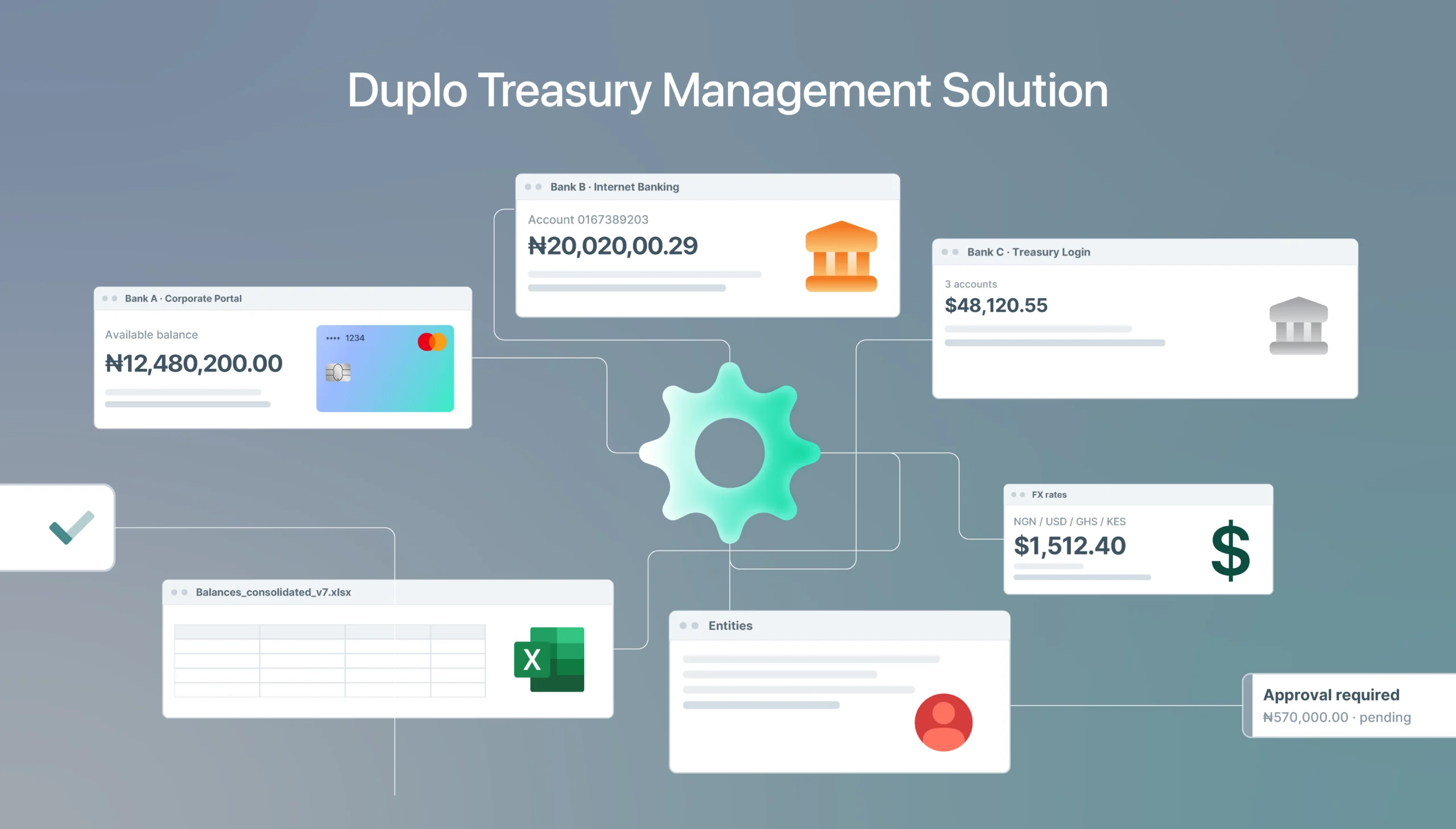
Multi-depot budget management. Configure separate budgets and approval chains for each depot or distribution centre. Depot managers see their own data. Group finance sees the consolidated position across all locations in real time.
Trade promotion spend controls. Campaign-level budget configuration with hard stops. Field-initiated promotional expenses routed through mobile approval workflows with real-time budget tracking. No campaign overspend without explicit authorization.
Procurement approval workflows. Configure tiered approval thresholds for stock replenishment, fleet maintenance, and operational procurement. Routine reorders from approved suppliers auto-approve. Non-standard or above-threshold purchases route to the correct authorizer automatically.
Auto reconciliation with QuickBooks, Sage, and Xero. Every payment matched to its purchase record and posted to your accounting system automatically. Multi-depot financial data consolidated without manual aggregation.
The Path Forward
The Nigerian FMCG sector is in a period where margin improvement is driven more by cost discipline than by top-line growth. Combined profits among Nigeria’s leading consumer goods companies grew 19.6% in Q1 2026 despite largely flat revenues, demonstrating that the businesses capturing margin improvement in this environment are those managing their cost base with precision.
For FMCG manufacturers and distribution companies, that precision requires visibility and control that manual processes and disconnected finance tools cannot deliver. The supplier payment reliability that maintains supply allocation, the FX cost management that reduces the drag on imported input costs, and the field expense visibility that gives trade marketing accurate campaign ROI data are all achievable with the right spend management infrastructure.
? Duplo is built to deliver that infrastructure for Nigerian FMCG and distribution businesses. Click here to see it in action!
Frequently Asked Questions
What are the biggest spend management challenges for Nigerian FMCG companies? The five most significant are: high-volume supplier payment cycles that require precision timing to maintain supply allocation; FX costs on imported raw materials and inputs that are not actively managed; field sales and trade marketing expense leakage from informal cash advance processes; multi-depot spend visibility gaps that prevent real-time cost management; and trade promotion spend that happens in the field without budget controls.
How do Nigerian FMCG companies reduce FX costs on imported inputs? By holding USD balances in a multi-currency wallet and paying USD-denominated suppliers directly from that balance, eliminating the naira-to-USD conversion cost on every individual transaction. Timing conversions strategically using a platform like Duplo’s Instant FX Swap, which shows the full FX cost before confirmation, reduces the effective cost of imported inputs compared to reactive conversion at bank rates.
How do I manage field sales expenses across multiple territories in Nigeria? Use a spend management platform with mobile expense capture that requires field sales representatives to submit receipts with territory and campaign codes at the point of purchase. Automated approval routing and reconciliation against campaign budgets gives finance real-time visibility into field costs without waiting for cash advance reconciliation at month-end.
Can Duplo handle bulk supplier payments for FMCG distribution companies? Yes. Duplo supports bulk payments to up to 500 suppliers in a single run via CSV, API, or dashboard. Automated purchase order matching and duplicate payment detection are built into the workflow before payment release, reducing processing overhead and error rates on high-volume FMCG supplier payment cycles.