
A single-location business with 30 employees can hold its spending together through personal oversight and direct communication. The finance manager knows most of the vendors, sees most of the transactions, and can chase down an unusual charge without a formal process.
The moment that business opens a second location, something shifts. There is now spending happening in a place the finance manager cannot see directly. Approvals happen locally. Vendors are chosen by branch managers without central visibility. Budget positions in Lagos do not reflect what has been committed in Abuja or Port Harcourt. And at month-end, the consolidated picture is assembled manually from reports that arrived in different formats, using different categories, from teams using different tools.
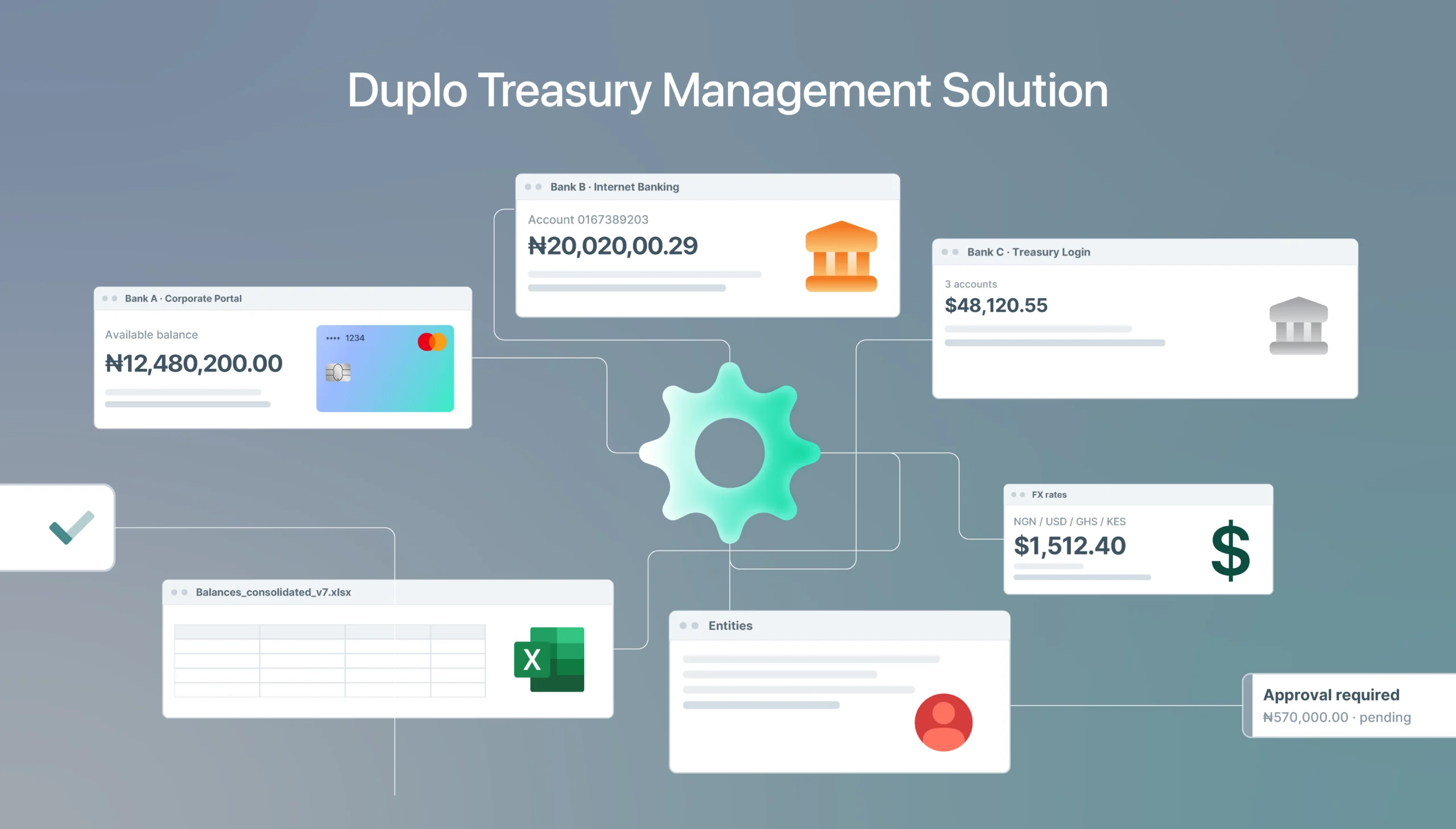
Multi-location operations magnify the usual pain points of spend control: fragmented data, inconsistent policy execution, slow approvals, and delayed reporting. Each location often uses its own tools and data coding structures for purchase orders, card transactions, and employee expenses. Files arrive at head office in different formats, with inconsistent categorization, making consolidation slow and error-prone.
Managing several entities without an integrated system often leads to inefficiencies that drain time and resources. Teams spend hours on manual reconciliations, shifting attention away from tasks that could add real value.
This guide covers the specific spend management challenges that multi-location businesses face and what a connected system changes.
The Three Core Spend Management Challenges for Multi-Location Businesses
Challenge 1: Policy Drift Across Branches
Even when a global policy exists, nuances emerge as it is interpreted by regional managers. Thresholds for approvals, treatment of per diems, or preferred suppliers gradually diverge, creating inequity and opening loopholes for overspend. In highly regulated markets, that drift can also expose the business to compliance risk if tax documentation, receipts, or entertainment rules are not applied correctly.
Policy drift is not the result of branch managers deliberately ignoring policy. It is the result of policy that lives in a document rather than a system. When the enforcement mechanism is a manager’s memory and a periodic reminder from finance, interpretation varies. What is approved at one branch would be rejected at another. Employees discover which branches have looser enforcement and route purchases accordingly.
Challenge 2: Fragmented Spend Data With No Consolidated View
Without proper financial coordination, each entity might operate in isolation, creating data silos that make it difficult to understand the company’s true financial position. This fragmentation causes inefficient decision-making, compliance risks, and missed opportunities for growth.
For a finance team at headquarters trying to understand the consolidated spend position across five branches, fragmented data means:
- Each branch submits expense reports in a different format.
- Budget positions at each location are maintained in separate spreadsheets.
- Vendor payment records live in the branch manager’s email or a local accounting tool.
- Consolidation requires manually importing, reformatting, and reconciling data from five sources before any analysis can begin.
According to a 2025 CFO Agenda report, 50% of finance professionals prioritize moving away from spreadsheets because they are error-prone and lack the real-time access required for modern consolidated reporting.
Challenge 3: Approval Bottlenecks That Push Branches Toward Workarounds
In a multi-location business without a connected spend management system, the approval chain for a branch purchase typically runs through a headquarters-based approver who is not always available and does not always have context on local operational needs. The result is delays that push branch managers to make purchases without waiting for approval, because the operational need is immediate and the formal process is too slow.
The old way of working, manual checks, reactive policies, fragmented systems, cannot keep up. The illusion of spend control is being replaced with the real thing: intelligent, centralized, real-time governance.
What Spend Management Should Look Like Across Multiple Locations
The following table compares how spending is managed without a connected system versus what a connected multi-location spend management platform delivers:
| Dimension | Without Connected Spend Management | With Connected Spend Management |
| Budget visibility | Each branch maintains its own spreadsheet; HQ consolidates manually at month-end | Live dashboard showing actual and committed spend by branch in real time |
| Policy enforcement | Policy document interpreted differently at each branch | Same rules applied automatically across every location |
| Approval process | Email or phone to HQ; delays push branches to buy without approval | Branch-level approval chains configured per location with mobile access |
| Expense submission | Different formats from each branch, consolidated manually | Single submission format across all branches, auto-reconciled |
| Vendor management | Each branch uses its preferred vendors without central visibility | Approved vendor list enforced across all locations |
| Reporting | Weeks after month-end once manual consolidation is complete | Available on demand, across all branches, in real time |
How to Structure Spend Management Across Branches and Entities
A connected multi-location spend management system needs to balance two things that appear to be in tension: central control and local operational flexibility. The businesses that get this right configure their system around a clear principle: central visibility with local execution.
What that looks like in practice:
Centrally configured, locally executed approval workflows. HQ sets the approval thresholds, the policy rules, and the vendor restrictions. Branch managers execute purchases within those rules without needing to escalate every decision to headquarters. Anything outside the configured limits routes upward automatically.
Entity-level budgets with group-level visibility. Each branch has its own budget, its own cost centres, and its own reporting view. The group finance team has a consolidated view across all entities simultaneously. Neither level of visibility compromises the other.
Consistent expense submission across all locations. Every employee at every branch submits expenses through the same workflow with the same policy rules applied. The expense data from Abuja and Lagos arrives in the same format and maps to the same chart of accounts, eliminating the reformatting work that manual consolidation requires.
Uniform vendor controls. An approved vendor list enforced at the platform level ensures branch managers cannot route purchases to unapproved suppliers regardless of local preference or convenience.
A Diagnostic for Multi-Location Spend Control
If three or more of the following describe your business, you have a multi-location spend management problem that a connected system will immediately improve:
- Month-end consolidation requires manually importing data from multiple branches.
- You cannot see the current spend position across all branches without running a report.
- Branch managers have approved purchases that would not have been approved at headquarters.
- Different branches use different vendors for the same categories of spend.
- A branch has exceeded its budget before finance was aware it was under pressure.
- Expense submissions from different branches arrive in different formats.
- Approval for branch purchases routes through someone at HQ who is not always available.
- You have discovered unauthorized spend at a branch through a bank statement rather than through a flagged approval.
How Duplo Manages Spend Across Multiple Locations and Entities
Duplo is built for African businesses operating across multiple locations, whether that is multiple branches within Nigeria, operations across Nigeria and South Africa, or a growing business adding new entities as it scales.
Entity-level budget configuration. Set separate budgets, approval chains, and spend limits for each branch or entity. Finance at each location sees its own data. Group finance sees everything.
Centrally enforced spending policies. Policy rules configured once at group level and applied automatically across every branch. No interpretation drift. No location-specific workarounds.
Multi-level approval workflows by location. Approval chains configured to reflect the actual authorization structure at each branch, with escalation to group finance for out-of-policy or above-threshold requests.
Consolidated real-time dashboards. See actual and committed spend across all branches simultaneously. Drill into any branch or any transaction in two clicks without waiting for manual consolidation.
Uniform expense submission. Mobile receipt capture and the same submission workflow for every employee at every location. Expense data arrives in a consistent format that maps automatically to your chart of accounts.
Integrations with QuickBooks, Sage, and Xero. Spend data from every branch flows into your accounting system automatically. Multi-entity consolidation happens in the platform, not in a spreadsheet.
The Path Forward
The question is not whether your organization will face spend control challenges as it grows across locations. It is whether your systems are built to flex as those challenges grow.
The multi-location spend management problem does not resolve itself with more branch managers or more frequent reporting cycles. It resolves when the system connecting all locations gives headquarters live visibility and consistent policy enforcement without removing the operational flexibility that branch-level management requires.
For African businesses expanding across cities, states, or countries, that infrastructure is available today. The businesses that build it early maintain control through growth. Those that delay find themselves rebuilding spend management from scratch at the moment they can least afford the distraction.
? Duplo is built for that transition. Click here to book a demo with a member of our team
Frequently Asked Questions
What is multi-location spend management? Multi-location spend management is the practice of controlling, tracking, and reconciling business spending across multiple branches, offices, or entities from a centralized system. It combines entity-level budget management and approval workflows with group-level visibility and reporting, so headquarters has a consolidated view of all spending while each location operates with appropriate autonomy.
Why is spend control harder in multi-location businesses? Because spending happens in places that headquarters cannot directly observe. Each location may use different tools, different vendors, and different approval processes, creating fragmented data that is difficult to consolidate and inconsistent policy enforcement that creates loopholes. The solution is a connected system that enforces the same rules across all locations while giving each branch the operational flexibility it needs.
How do I prevent policy drift across branches? By enforcing policy through a system rather than a document. When spending rules are configured in a platform that applies them automatically at the point of submission, regardless of which branch the employee is in, the interpretation gap that causes policy drift is eliminated. Branch managers work within the same rules as headquarters without needing to be reminded of them. record was created automatically at every step.