
The CFO of a Nigerian conglomerate with five subsidiaries, twelve active bank accounts, and operations across Lagos, Abuja, and Port Harcourt does not have a cash visibility problem in the conventional sense. She knows the cash exists. However, to see exactly where it sits, how much is committed or available, which entities hold idle cash, and which approach overdraft, she must log into multiple banking portals, pull statements, and manually combine figures. By then, the data is already hours old.
That is not a cash flow problem. It is a treasury infrastructure problem. For businesses navigating this complexity, treasury management is becoming an increasingly important priority. As companies expand across multiple entities and markets, they need better ways to manage fragmented banking relationships, liquidity, and financial data.
Expansion and acquisition activity are also reshaping treasury priorities across Africa. As businesses grow, treasury teams must manage financial environments that were never designed to work as a single system. Better enterprise treasury management can help businesses address this fragmentation with greater visibility, automation, and control.
Duplo now addresses this challenge with Duplo Treasury Management. The platform gives African businesses greater control across every bank, entity, and account they operate. It also helps finance teams centralise liquidity, improve cash visibility, and make faster treasury decisions.
For enterprise and mid-market businesses, effective treasury management can provide the infrastructure needed to manage growing financial complexity without relying on disconnected banking portals and manual processes.
The Problem Duplo Treasury Management Is Built to Solve
Most enterprise and mid-market African businesses manage treasury the same way they did five years ago: manually, reactively, and across too many disconnected systems.
The typical picture looks like this. Multiple banks hold cash across separate accounts, leaving teams without a consolidated view. Finance teams initiate bulk payments manually, one by one, and reconcile them days later. Each entity maintains its own banking relationships and records, making real-time visibility across the group difficult. Treasury teams also rely on historical data for forecasting, often receiving it too late to guide today’s decisions. Meanwhile, teams build audit trails from email threads, bank statements, and approval records stored across different systems.
As a result, treasury teams spend more time tracking cash than optimising it. One entity may leave funds idle while another approaches overdraft. Short-term borrowing can also increase financing costs when better liquidity management could reduce the need for it. Meanwhile, the CFO may present the board with a cash position that reflects two days ago rather than today.
This challenge affects businesses worldwide. However, African enterprises face additional complexity from FX volatility, fragmented banking relationships across markets, regulatory requirements, and rapid business growth. Many companies have expanded faster than their treasury processes could keep up.
What a Treasury Management System Actually Does
Before introducing Duplo’s treasury management platform, it is worth being precise about what a treasury management system is and what it is not.
A treasury management system consolidates cash positions across all entities, automates bank connectivity, and integrates with ERP and financial systems to give the treasury function a single, real-time view of the organisation’s cash. It replaces manual bank portal logins, spreadsheet aggregation, and reactive forecasting with automated data collection, intelligent analysis, and proactive liquidity management.
The most advanced enterprise treasury management platforms in 2026, including Kyriba, GTreasury, HighRadius, and SAP, provide end-to-end cash, risk, and liquidity management for large global enterprises. They are powerful. They are also built for Western corporate treasury functions, priced for enterprise IT budgets, and designed around banking infrastructure that does not reflect the African operating reality.
What African enterprise businesses need is a treasury management platform built for their specific context: multi-bank connectivity via NIBSS, ERP integration with the platforms their finance teams actually use, FX management across Nigerian naira and major foreign currencies, and a compliance and governance framework that satisfies CBN and regulatory requirements.
That is what Duplo Treasury Management is built to deliver.
Duplo Treasury Management: Centralised Liquidity. Intelligent Control.
Duplo’s treasury management platform transforms fragmented treasury oversight into centralised, intelligent liquidity management. It gives finance teams greater control across five core capability areas.
1. Multi-Bank Cash Visibility in Real Time
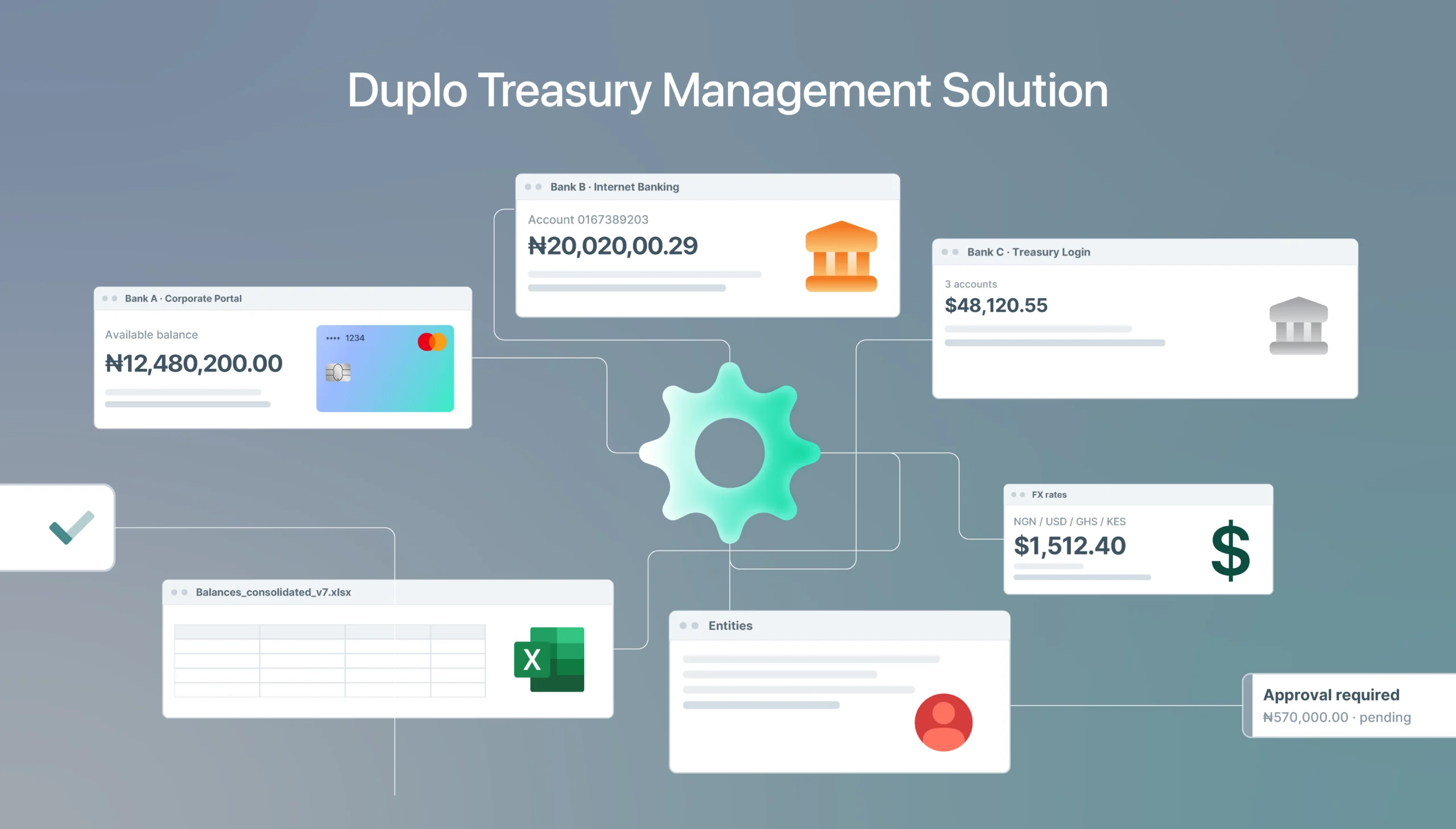
Duplo connects bank accounts across every entity and consolidates them into a single dashboard. NIBSS connectivity keeps the dashboard updated in near real time. Finance teams can assign aliases to each entity, filter balances by bank, department, and volume, and track connected and pending integrations from one place.
Instead of logging into twelve banking portals to understand the organisation’s cash position, the CFO can view consolidated balances in one place and see the latest transaction activity without manually combining statements.
The result: Full financial visibility across all entities. One view. No manual bank portal logins.
2. Automated Cash Sweeping
Duplo’s treasury management platform lets treasury teams create rules that automatically move funds between accounts based on configured thresholds. The platform consolidates excess liquidity centrally instead of leaving funds idle in subsidiary accounts. It also maintains minimum balances across every entity and moves funds where they are needed before a deficit occurs, helping reduce overdraft exposure.
The result: Better use of idle cash. Lower financing costs. A treasury function that moves from reactive to proactive.
3. AI-Powered Reporting and Forecasting
Duplo Treasury Management gives finance teams drill-down reporting by category, department, and recipient. It also tracks volume trends and uses AI to forecast near-term liquidity needs. Finance teams can identify unusual spend patterns, anticipate liquidity requirements, and build budgets using current data instead of historical approximations.
AI-powered forecasting increasingly plays a role in modern treasury management. Advanced platforms use AI to improve forecasting, support financial decisions, and help treasury teams take a more strategic approach to liquidity. Duplo Treasury Management brings these capabilities to African enterprise businesses without the pricing and implementation complexity often associated with global enterprise platforms.
The result: Smarter budgeting. Proactive liquidity planning. Treasury that advises rather than simply reports.
4. Single and Bulk Vendor Payments
Duplo’s treasury management platform connects payment execution directly to the treasury workflow. Finance teams can initiate single and bulk vendor payments from the same platform they use for cash management and forecasting.
With Microsoft Dynamics 365 integration, the platform receives payment instructions directly from the ERP, eliminating manual data re-entry. Finance teams can then execute each payment through the same approval workflow and audit trail that supports other treasury activities.
The result: Payment execution connected to treasury oversight. No separate payment platform. No manual data transfer between systems.
5. Enterprise Governance and Control
Duplo Treasury Management records transaction activity, tracks approvals, and gives finance teams visibility into payment initiation across all entities. The platform documents every treasury action from initiation through execution, creating a complete audit trail that teams can access when needed.
For Nigerian enterprises subject to CBN compliance requirements, this built-in governance infrastructure reduces the work required to prepare for audits. Instead of reconstructing financial activity when an auditor arrives, finance teams maintain the audit trail continuously as they manage treasury operations.
The result: Audit-ready treasury operations. Complete governance without additional administrative overhead.
Who Duplo Treasury Management Is Built For
Duplo’s treasury management platform is designed for enterprise and mid-market Nigerian and African businesses that:
- Need to meet CBN and other regulatory requirements with complete, accurate, and accessible audit trails.
- Manage multiple bank accounts across two or more financial institutions without a consolidated view of their cash.
- Operate multiple entities, subsidiaries, or departments with separate banking relationships and fragmented financial reporting.
- Rely on manual bulk payment processes that consume finance team time and operate separately from treasury oversight.
- Use reactive cash forecasting based on historical data instead of real-time cash positions and AI-driven predictions.
- Use ERP systems, particularly Microsoft Dynamics 365, without connecting them to their treasury and payment workflows.
How Duplo Treasury Management Fits Into the Broader Duplo Platform
Duplo Treasury Management does more than sit alongside Duplo’s existing platform. It serves as the enterprise layer that connects the wider financial operation.
A business that uses Duplo for payments, expense management, NRS e-invoicing, and reconciliation already has the transactional infrastructure in place. Duplo Treasury Management adds the intelligence layer on top. It brings together multi-bank visibility, automated cash sweeping, AI forecasting, and enterprise governance while connecting them to the same payment and financial operations data the business generates through Duplo.
The result is a complete financial operating system for African enterprises. Duplo Payments handles business payment execution, while Duplo Finance manages expenses and compliance. Meanwhile, Duplo Treasury Management gives enterprises greater control over their cash. Because every layer shares the same data, approval infrastructure, and audit trail, each one strengthens the value of the others.
The Path Forward
The global treasury management software market could reach USD 26.68 billion in 2026, with African enterprises driving a growing share of demand. However, these businesses need more than the tools global enterprise CFOs typically use. They need treasury infrastructure that fits their operating environment. That means connectivity with NIBSS, integration with the ERPs their finance teams use, support for multi-bank Nigerian operations, and solutions built for African enterprises.
Duplo provides that infrastructure. Enterprise and mid-market Nigerian businesses can use it today to replace fragmented treasury oversight with centralised, intelligent liquidity management.
If you currently log into twelve banking portals to understand your organisation’s cash position, Duplo can help you bring that visibility into one place. Start here.
Frequently Asked Questions
What is Duplo Treasury Management?
Duplo Treasury Management is Duplo’s enterprise treasury management platform, designed for African businesses managing cash across multiple bank accounts, entities, and currencies. It provides near real-time multi-bank cash visibility via NIBSS connectivity, automated cash sweeping rules, AI-powered reporting and liquidity forecasting, single and bulk vendor payment execution, ERP integration with Microsoft Dynamics 365, and complete enterprise governance and audit trail infrastructure, all from a single dashboard.
What is a treasury management system and why do African enterprises need one?
A treasury management system is software that consolidates cash positions across all entities, automates bank connectivity, and integrates with ERP and financial systems to give treasury teams a real-time view of the organisation’s cash. African enterprise businesses need one because growth across multiple entities and banking relationships creates fragmented cash visibility, manual reconciliation overhead, reactive forecasting, and governance gaps that a spreadsheet-based approach cannot resolve. Duplo Treasury Management is built specifically for the African operating context, including NIBSS connectivity and CBN compliance infrastructure.
How does automated cash sweeping work?
Automated cash sweeping allows treasury teams to set rules that automatically move funds between accounts based on configured thresholds. When a subsidiary account exceeds its maximum balance, excess funds sweep to a central treasury account automatically. When an account approaches its minimum balance, funds are transferred in to prevent overdraft. The rules run continuously without manual intervention, ensuring idle cash is consolidated, and financing costs are minimised.
Which ERP systems does Duplo Treasury Management integrate with?
Duplo Treasury Management currently integrates with Microsoft Dynamics 365. This integration allows payment instructions to flow from the ERP into the platform without manual re-entry, connecting treasury management and payment execution directly to the enterprise resource planning system the finance team already uses.
Who is Duplo Treasury Management designed for?
Duplo Treasury Management is designed for enterprise and mid-market Nigerian and African businesses with multiple bank accounts and entities, high payment volumes, ERP systems requiring treasury integration, and CBN compliance obligations. It is particularly suited to businesses that have grown rapidly across multiple subsidiaries and are managing treasury fragmentation as a direct consequence of that growth.