In most businesses, a payment that arrives a day late is an inconvenience. In logistics, it can be the direct cause of a service failure.
A delayed or expensive international transaction can stall cargo at ports, disrupt supply chain schedules, and cause financial strain for logistics firms. A late payment can be just as disruptive as a mechanical failure or a port strike. A container that cannot be released because a port handling charge has not cleared is accumulating demurrage fees of USD 150–300 per day. A freight forwarder waiting on funds from last week’s job will not prioritize your next shipment. A customs broker who has not been paid will not be available when you need urgent clearance.
According to the African Development Bank, payment system inefficiencies across Africa add 20–25% to the cost of cross-border trade. For logistics companies operating on thin margins across multiple corridors, that overhead is not abstract. It shows up in every delayed shipment, every strained partner relationship, and every demurrage invoice that could have been avoided.
This guide covers what makes cross-border payments uniquely complex for African logistics businesses and what modern payment infrastructure makes possible.
Why Logistics Payments Are More Complex Than Most Cross-Border Transactions
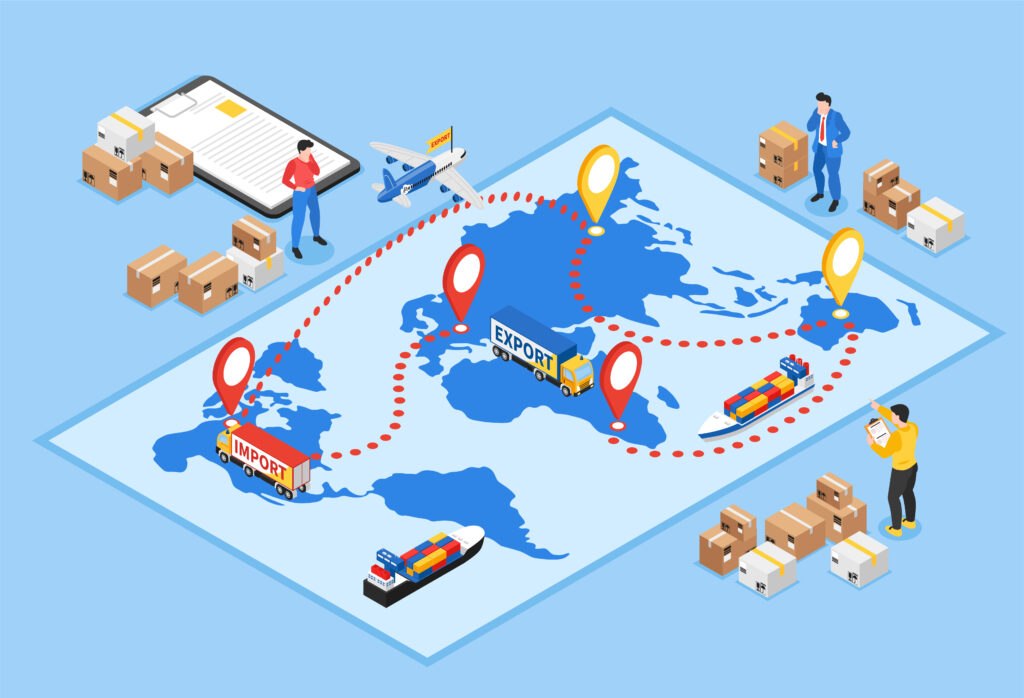
A single cargo movement from Lagos to Rotterdam does not generate one payment. It generates several, each in a different currency, to a different counterparty, on a different timeline:
- Naira for domestic trucking, port handling, and local customs fees.
- USD for the ocean freight invoice from the shipping line.
- EUR for destination clearance, delivery, and agent fees in the Netherlands.
- Additional currencies for fuel surcharges, insurance, or transit port fees.
Each of these payments has its own compliance requirements, its own FX conversion if you do not hold the relevant currency, and its own settlement timeline. Managing all of them through a single-currency bank account and a series of individual wire transfers creates a structure that is administratively expensive, FX-heavy, and slow enough to create operational risk on time-sensitive shipments.
Among freight and logistics companies surveyed globally, 36% identified multi-currency payment support as one of the top three features that would most benefit their payment processes. For African logistics businesses operating across the continent’s fragmented payment corridors, it is not a nice-to-have. It is a structural requirement.
The Demurrage Problem: When Payment Speed Becomes an Operational Risk
Demurrage is the cost that crystallizes when payment is slow. A container held at a port beyond its free detention period starts accumulating daily charges immediately. At USD 150–300 per day per container, a five-day correspondent banking settlement on a port handling charge is not just a delay. It is a cost that can exceed the original payment itself.
The logistics businesses that avoid this consistently have built payment infrastructure around one principle: settlement speed on critical corridors must exceed what operations require. If your freight forwarder in Singapore needs cleared funds by Wednesday morning to release documents, you need a payment platform capable of same-day or next-day settlement from West Africa, not one that tells you to allow three to five business days.
The practical steps that reduce demurrage risk from payment delays:
- Know the settlement time on every corridor you use regularly, not just the headline claim from your provider.
- Pre-fund high-frequency payment corridors so funds are available immediately when a payment is triggered.
- Use a platform with real-time tracking so you can confirm delivery to a partner before they chase you.
Managing Multi-Currency FX Costs Across Logistics Corridors
A logistics company handling freight on multiple international corridors is continuously exposed to FX movements. USD-denominated ocean freight, EUR-denominated European charges, and local African currency obligations across every market where goods transit create a natural multi-currency position that most logistics businesses manage reactively: converting whatever is needed at the moment each invoice lands.
Reactive FX conversion is expensive because it accepts whatever rate is available under time pressure. A logistics business that regularly receives EUR from European clients and regularly pays EUR-denominated destination charges has a natural offset it is not using if it converts EUR receipts to naira on arrival and then reconverts to EUR for the next payment. That cycle involves two FX spreads on what is effectively a pass-through transaction.
The fix is straightforward: hold multi-currency balances and deploy them directly. Receive EUR, hold EUR, pay EUR. The conversion cost on that cycle drops to near zero.
Partner Relationships and the Payment Reliability Advantage
The commercial relationships that logistics businesses depend on, freight forwarders, customs brokers, bonded warehouse operators, overseas agents, are built on consistent behavior over time. Payment reliability ranks at the top of the behaviors that matter to these partners.
A logistics company known for paying quickly and with accurate reference data is treated differently from one known for slow payments or unclear remittance details. During peak season or when capacity is constrained, partners allocate priority to clients whose payments are predictable. That preferential treatment is not formal. It is the accumulated result of payment reliability demonstrated over months and years.
Real-time payment tracking and delivery confirmation give logistics businesses a concrete way to demonstrate this reliability. Rather than telling a partner a payment has been sent, you can show them the timestamp of when it arrived.
How Duplo Supports African Logistics and Supply Chain Payments
Multi-Currency Wallets. Hold USD, EUR, and NGN in a single wallet. Pay freight forwarders in USD, European agents in EUR, and domestic partners in naira from the same platform without triggering a conversion on every transaction.
Faster settlement on key corridors. We use local banking networks to deliver settlement significantly faster than correspondent chain routing. On time-sensitive freight corridors, the difference between same-day and three-day settlement is the difference between cleared cargo and a demurrage invoice.
Bulk Payments. Pay up to 500 partners, agents, and suppliers in a single run. Consolidate weekly partner settlement runs rather than initiating transfers individually across multiple relationships.
Real-Time Tracking and Auto Reconciliation. Track every payment from initiation to delivery. Share confirmation timestamps with partners in real time. Every transaction is automatically reconciled against its corresponding service record, so month-end close does not become a manual matching exercise across multiple currencies and bank accounts.
Compliance built in. Duplo handles KYC, AML, and cross-border documentation requirements inside the payment workflow. Bills of lading, invoices, and payment records stay aligned so funds clear without compliance holds mid-transfer.
The Path Forward
Africa’s cross-border road freight market is projected to grow from USD 9.5 billion in 2024 to USD 18.5 billion by 2033. Under AfCFTA, digital customs systems and electronic payments are already reducing friction in cross-border commerce, and logistics businesses that build the payment infrastructure to match will be better positioned to capture that growth than those still managing multi-currency operations through single-currency bank accounts and manual transfers.
The operational improvements available from modern payment infrastructure, faster settlement, lower FX costs, real-time visibility, are not waiting for the African payments landscape to mature further. They are available now, to logistics businesses willing to make the switch from a system that was not built for their operational reality to one that is.
? Duplo is built for exactly that. Get started when you book a demo with a member of our team today.
Frequently Asked Questions
How do I pay international freight forwarders and agents from Nigeria? Use a cross-border payment platform like Duplo that supports payments in USD, EUR, and other major currencies directly into overseas bank accounts. Real-time delivery confirmation means your partners know funds have arrived without needing to chase you.
How do I avoid demurrage charges caused by slow payments? The most reliable way is to use a payment platform with same-day or next-day settlement on your key freight corridors, rather than bank wire transfers that take two to five business days. Pre-funding high-frequency payment corridors also eliminates settlement lag on time-critical charges.
How do I manage multiple currencies across different logistics corridors? Hold USD, EUR, and NGN in a multi-currency wallet and pay each counterparty from the relevant currency balance. This eliminates the FX cost of converting to local currency and back on every transaction.
How do I reconcile payments across multiple logistics partners and currencies? Use a platform with auto reconciliation that matches each payment to its corresponding service record automatically. This is particularly important for logistics businesses with high payment volumes across multiple corridors and currencies.port payment obligations in the same currency before converting the net position.