
The spreadsheet has been the backbone of finance team operations for four decades. It is flexible, familiar, and free. It does exactly what you tell it to do. And therein lies the problem: it does only what you tell it to do, when you tell it, by the person you told to do it. In a small business with predictable spending and one finance manager, that is manageable. In a growing business with multiple departments, multiple locations, and dozens of people making purchasing decisions simultaneously, it is a system that creates the illusion of control while the real spending happens elsewhere.
In 2026, 67% of companies with more than 250 employees still use Excel for account analysis and reconciliation, including 62% of mid-sized businesses and 66% of larger organisations. More than one in three CFOs are not highly confident in the reliability of their own figures. That matters because weak data reliability can expose companies to compliance failures, damage credibility with senior management and investors, and delay the detection of fraud.
CFOs are moving away from Excel-based processes toward modern financial platforms that provide live data access, automate reporting workflows, and support multi-entity environments. Financial reporting in 2026 is no longer a back-office function. It is a real-time, decision-driving capability.
This is not a technology trend story. It is a business performance story. The CFOs moving away from spreadsheets for spend management are not doing it because their software vendor told them to. They are doing it because the spreadsheet stopped working.
Why Nigerian Startups Delay Spend Management and What It Costs Them
What Spreadsheets Were Actually Built For
Spreadsheets are calculation tools. They were designed to perform arithmetic on structured data: to add columns, apply formulas, and produce outputs that a human can read and act on. They do this exceptionally well, which is why they became the default tool for almost every financial process that involved numbers.
What spreadsheets were not designed for:
- Real-time data capture. A spreadsheet is updated when a human updates it. Between updates, it reflects a historical state, not the current one. For spend management, where the value of the data depends on its recency, this is a fundamental limitation.
- Workflow automation. A spreadsheet can record an approval but it cannot route a request to an approver, send a notification, escalate when no action is taken, or enforce a policy rule automatically.
- Multi-user simultaneous access. Multiple people updating the same spreadsheet simultaneously creates version conflicts, overwriting errors, and reconciliation problems that consume significant finance team time.
- Audit trails. A spreadsheet records what is in it, but not the history of how it got there. Cells can be edited without a record of who changed what, when, and why.
- Integration with payment systems. A spreadsheet that records an approved expense cannot trigger a payment. The payment has to be initiated manually in a separate system, creating the gap between authorization and execution where errors, delays, and unauthorized payments accumulate.
As the business grows, spreadsheet-driven workflows reach a limit. Finance teams spend more time fixing errors than analyzing trends. Relying on fragmented systems leads to inefficiencies and data silos, making integrated software solutions essential for modern financial management.
The Five Specific Ways Spreadsheets Fail at Spend Management
1. They show what happened, not what is happening.
A spend management spreadsheet updated every Friday morning reflects the state of spending as of Thursday end of day. Any purchase made Friday, any approval given over the weekend, any vendor invoice that arrived Monday morning: none of it is in the data until someone adds it. The CFO reviewing the spreadsheet is always looking at the past, never the present.
2. They cannot enforce policy before spending happens.
A spreadsheet can record that a purchase violated policy. It cannot prevent the violation from occurring. There is no mechanism in a spreadsheet to block a transaction that exceeds a budget limit, route a purchase request to the correct approver, or flag a vendor that is not on the approved list. These controls require a system, not a document.
3. They create reconciliation work rather than eliminating it.
Manual expense data often lives in disconnected systems or spreadsheets, eliminating the real-time insights needed to enforce budget controls and identify off-policy spending. Almost 27% of the 371,000 expense claims analyzed in the 2025 Expense Trends Report were approved after 30 or more days. A finance team managing spend through spreadsheets spends a significant share of its capacity each month transferring data between systems, reconciling figures that should agree but do not, and tracing discrepancies back to their source through email threads and chat messages.
4. They do not scale with the business.
A spreadsheet that manages spend adequately for a team of fifteen becomes unreliable at fifty and unmanageable at one hundred. The number of rows grows. The number of people touching it grows. The version control problems grow. The formulas that worked at small scale break under large-scale data. The CFO ends up maintaining a more complex spreadsheet rather than moving to a system built for the actual complexity of the business.
5. They are a single point of failure.
The spend management spreadsheet typically lives in one person’s knowledge: the finance manager who built it knows what each formula does, why each column exists, and what to do when something breaks. When that person leaves, is unavailable, or simply has a busy week, the spend management function degrades immediately.
What CFOs Are Moving To Instead
Finance teams are reaching the limits of spreadsheet-based processes after a year in which reporting cycles became tighter, and expectations on speed and accuracy increased. Many organizations are now consolidating tools for reporting, consolidation, forecasting, and planning into a single finance ecosystem. Finance leaders are reassessing the technology foundations of their functions.
The shift is not from spreadsheets to a more sophisticated spreadsheet. It is from a reactive, manually maintained document to a connected system that automates the processes a spreadsheet required humans to run. The key capabilities CFOs are prioritizing in that shift:
Live spend dashboards that show committed and actual spend across every department and cost centre as transactions are approved, not after they are recorded manually. The CFO reviewing spend data on a Tuesday afternoon is seeing Tuesday afternoon’s position, not last Friday’s.
Automated approval workflows that enforce the authorization structure the business has defined, route requests to the correct approver, escalate when no action is taken, and create an immutable audit trail as a byproduct of normal operations, without anyone maintaining it manually.
Pre-emptive budget controls that block out-of-policy purchases before they become payments rather than flagging them after the fact. The shift from documentation to prevention is the most important functional difference between a spreadsheet and a spend management platform.
Accounting system integration that eliminates the manual transfer of data between the spend record and the financial record. CFOs are shifting from reactive control to real-time control. The goal is not to block spending. The goal is to ensure each dollar has a clear owner, a clear purpose, and a clear limit before it leaves the business.
Audit trails that require no maintenance. Every transaction, approval, rejection, and amendment documented automatically from the moment a purchase request is submitted. When an auditor asks for a complete transaction history, the answer takes seconds rather than days.
How Duplo Replaces Spreadsheet-Based Spend Management
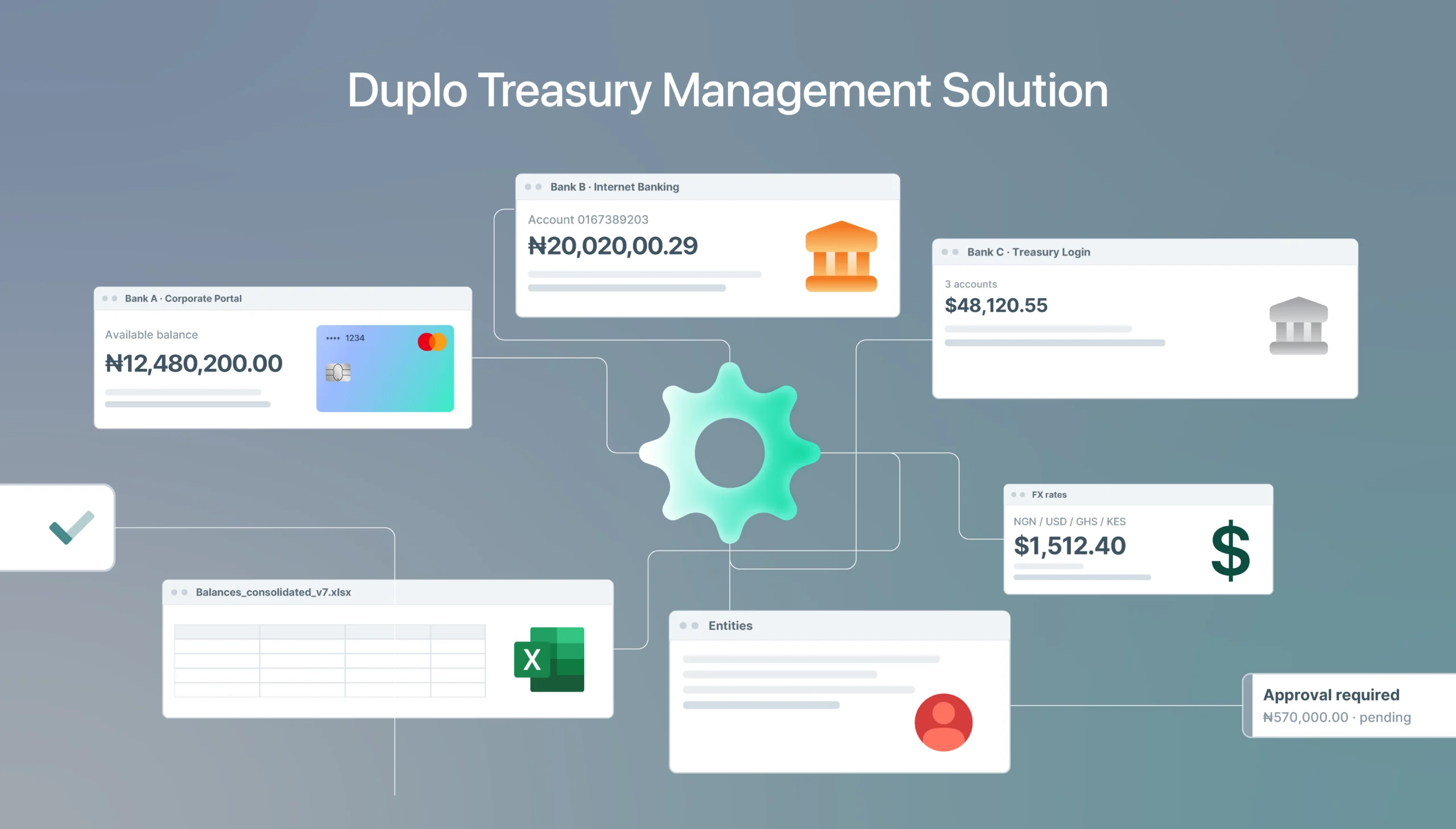
Duplo is built for African businesses that have reached the limit of spreadsheet-based spend management and need a connected system that gives finance real-time visibility and control without the manual overhead that spreadsheets require.
Real-time spend dashboards. Live committed and actual spend across every department and cost centre, updated as approvals are made. The finance team works from current data, not yesterday’s spreadsheet.
Automated approval workflows. Multi-level routing, mobile approvals, escalation rules, and immutable audit trails configured to the business’s actual authorization structure. No manual direction of approval requests. No WhatsApp approvals with no record in the system.
Pre-emptive budget controls. Hard stops on out-of-policy purchases. Staged alerts at 70%, 85%, and 100% of budget. Policy enforced before spending happens, not documented after.
Expense management with mobile receipt capture. Employees submit in under two minutes. Finance approves from their phone. Approved expenses reconciled automatically against the relevant budget.
Vendor payment management. Approved spend triggers payment directly within the same system. No separate manual initiation step. Full audit trail from request to payment.
Integrations with QuickBooks, Sage, and Xero. Every approved transaction flows into the accounting system automatically. Month-end close confirms what finance already knows rather than revealing what it did not.
CBN-licensed, PCI DSS certified, ISO certified, NDPC-registered. The regulatory framework that Nigerian businesses require, built into the platform from the start.
The Bottom Line
More than one in three CFOs are not highly confident in the reliability of their own figures. That is not a data quality problem. It is a systems problem. Spreadsheets were not designed to maintain the integrity of financial data across a growing organization with multiple people updating multiple figures simultaneously. They were designed to calculate. The gap between what spreadsheets were built for and what finance teams are using them for is where unreliable figures, missed budget overruns, and compliance gaps originate.
The CFOs moving away from spreadsheets for spend management are not early adopters of technology for its own sake. They are responding to a straightforward operational reality: the business has grown past the point where a manually maintained document can give them the control they need. The question is not whether to make the switch. It is how long to wait before the cost of not switching becomes impossible to ignore.
?Duplo is built for African businesses that are ready to make the switch now. Click here to upgrade your spend management system.
Frequently Asked Questions
Why are CFOs moving away from spreadsheets for spend management? Because spreadsheets cannot do what spend management requires: enforce policy before spending happens, route approvals automatically, provide real-time budget visibility, maintain immutable audit trails, or integrate with payment systems. As businesses grow, the gap between what spreadsheets were designed for and what finance teams need them to do creates compounding problems: unreliable data, missed overruns, and compliance gaps that a purpose-built spend management platform eliminates.
What do CFOs use instead of spreadsheets for spend management? Modern spend management platforms that automate approval workflows, enforce budget controls before spending happens, provide live dashboards showing committed and actual spend in real time, and integrate directly with accounting systems like QuickBooks, Sage, and Xero. The shift is from a manually maintained document to a connected system that runs the spend management process automatically.
How much do spreadsheet-based finance processes cost businesses? The costs are largely hidden. Finance teams in spreadsheet-based environments spend up to 40% of their time reconciling data rather than analyzing it. Expense claims are approved an average of 30 or more days after purchase in manual systems. More than one in three CFOs report low confidence in the reliability of their own figures. The direct cost of errors, overspends, and compliance failures adds to this, but the largest cost is the strategic one: decisions made on data that does not reflect the current state of the business.
Is Duplo suitable for businesses currently using spreadsheets for spend management? Yes. Duplo is designed to be the first spend management platform for businesses transitioning from spreadsheet-based processes, with fast implementation, self-serve configuration, and a user experience simple enough for the whole team to adopt quickly. CBN-licensed, PCI DSS certified, ISO certified, and NDPC-registered, it provides the regulatory compliance framework Nigerian businesses require from day one.odes at the point of purchase. Automated approval routing and reconciliation against campaign budgets gives finance real-time visibility into field costs without waiting for cash advance reconciliation at month-end.
Can Duplo handle bulk supplier payments for FMCG distribution companies? Yes. Duplo supports bulk payments to up to 500 suppliers in a single run via CSV, API, or dashboard. Automated purchase order matching and duplicate payment detection are built into the workflow before payment release, reducing processing overhead and error rates on high-volume FMCG supplier payment cycles.