

Most payment gateway failures in Nigeria are not business problems. They are engineering problems, invisible in dashboards and absent from finance reports until a client complains about a transaction that should have worked.
If you have integrated a payment gateway in Nigeria, three specific failure patterns are almost certainly costing your product revenue right now: inadequate retry logic, unoptimised latency, and insufficient uptime monitoring. This guide explains each one, how to detect it, and what good looks like.
Nigeria is not a small market for this problem. Digital wallets and bank transfer payments now account for approximately 30% of global point-of-sale volume, with Nigeria specifically among the highest-concentration markets, making payment success rate optimisation more critical than ever as transaction volume concentrates on fewer high-traffic rails. Every percentage point of failure rate you recover translates directly to revenue retained.
Why Nigerian Payment Gateway Integrations Fail Differently
Payment gateway integrations in Nigeria fail at higher rates than global averages for a specific structural reason: the infrastructure spans multiple rails simultaneously.
NIBSS Instant Payment handles real-time bank transfers. Card networks (Visa, Mastercard, Verve) handle card authorisations. USSD channels serve customers without smartphones. Virtual account systems handle invoice-linked collections. Each rail has its own failure characteristics: NIBSS experiences timeout spikes during high-traffic periods, card authorisations face higher decline rates on international cards, and USSD sessions have hard timeout windows that cannot be exceeded regardless of processing time.
A payment gateway integration not specifically engineered for these failure patterns will leak transactions continuously, not occasionally.
Leak 1: Retry Logic That Does Not Match the Failure Type
Every failed payment has a reason code. The most common engineering mistake is treating all failures identically: log the error, return a failure response, move on. This abandons recoverable transactions and creates duplicate charge risk on retried ones.
The correct approach is categorising failures by type and responding differently to each.
Retriable failures are transient: network timeouts, temporary bank unavailability, gateway queue overloads. These should trigger automatic retries with exponential backoff. Best practice is to wait progressively longer between retries, starting at 1 second, then 2 seconds, then 4 seconds, with a maximum retry limit to avoid infinite loops.
Non-retriable failures are permanent: insufficient funds, invalid account numbers, card blocked by issuer. Retrying these wastes processing resources and can trigger fraud detection flags on the card network. These should fail immediately with a clear, specific error returned to the user.
Idempotency keys are non-negotiable. Every payment request that may be retried must include an idempotency key: a unique identifier that prevents duplicate charges if the same request is submitted more than once. Without idempotency keys, a customer whose request timed out may be charged twice when your retry fires.
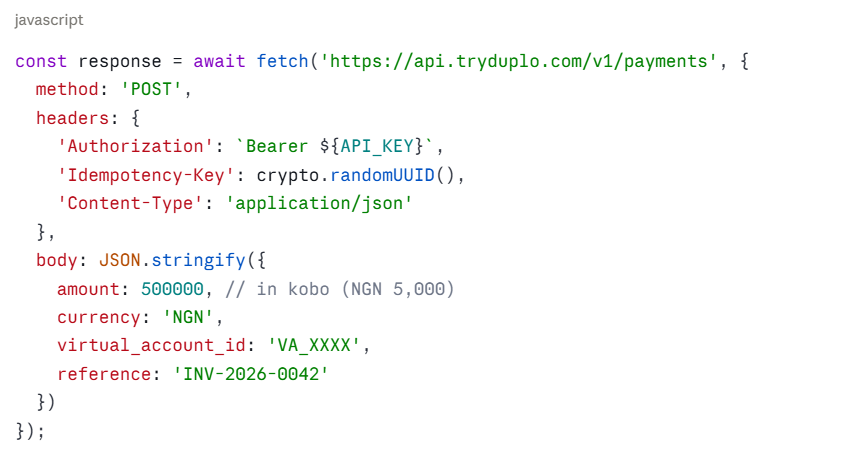
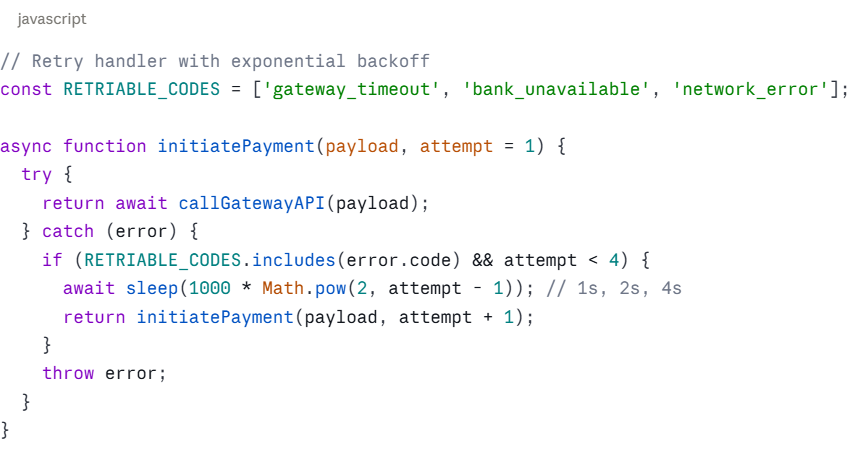
Your check: Does your integration distinguish retriable from non-retriable failures? Do all retry requests carry the original idempotency key? If not, you are either abandoning recoverable transactions or risking double charges on every network hiccup.
Leak 2: Latency That Kills Conversion and Reconciliation
Payment gateway latency in Nigeria is structurally higher than global benchmarks, and it varies significantly by payment method, time of day, and which gateway rail is handling the transaction.
Latency creates three distinct failure modes:
User abandonment. Users who do not see a payment response within a few seconds assume something has gone wrong. They refresh (risking a duplicate charge) or abandon entirely. A payment that was going to succeed becomes a lost transaction because the response was too slow.
Webhook delivery delays. High gateway latency in server-to-server flows pushes webhook delivery downstream. If your application depends on webhook receipt to confirm payment status, latency in the gateway layer delays every downstream process: inventory updates, confirmation emails, reconciliation runs.
USSD session expiry. USSD channels have hard session timeout limits set by the telco, not the gateway. If your payment gateway does not respond within the session window (typically under 180 seconds end to end), the transaction fails regardless of whether the underlying payment was processed. This is a failure mode with no recovery path.
How to measure your real latency: Do not rely on your gateway provider’s stated SLA. Log the timestamp at payment initiation and again at gateway response. Track by payment method and time of day. Nigerian payment infrastructure has predictable congestion windows: end-of-month salary periods, public holiday eve surges, and weekday morning banking hours all produce measurably higher latency.
For Nigerian bank transfer payments via NIBSS, response times under 3 seconds are achievable on well-optimised gateways. A gateway routing Nigerian payments through international intermediaries rather than direct NIBSS integration will consistently underperform on this metric.
Your check: Are you logging gateway response times per payment method and hour of day? Do you have latency alerting configured? Have you load-tested your integration during known Nigerian peak windows?
Leak 3: Uptime You Are Not Monitoring
Your payment gateway’s uptime is not your responsibility to maintain. It is your responsibility to monitor actively.
Most developers assume the uptime SLA they signed reflects actual availability. It does not. Businesses with robust failover mechanisms see a 30% improvement in overall system reliability, according to Gartner 2025, but that improvement only exists if failures are detected in real time, not hours later via customer complaints.
SLA uptime figures are typically averaged across time and often exclude planned maintenance, degraded performance periods, and partial outages affecting specific payment methods or regions. A gateway that is “99.9% up” in aggregate may have the NIBSS bank transfer rail failing intermittently during your peak transaction window. That shows up in your revenue, not in the SLA report.
What a proper monitoring setup requires:
Synthetic monitoring: A scheduled job that pings your payment gateway integration at regular intervals using test transactions in your sandbox environment. This gives you real-time detection of gateway failures before customers encounter them. The target is knowing about a failure before any customer does.
Webhook delivery monitoring: Webhooks are how your gateway tells your application a payment completed or failed. If webhooks are delayed or undelivered, your application does not know payment status, your database does not update, and your user does not get confirmation. Every webhook received should be logged with its event ID. Alert on gaps in expected delivery frequency.
Payment method fallback: Smart retry logic transforms failed payments from dead ends into recovered revenue, with intelligent routing selecting the best-performing payment methods and cost-efficient channels with faster response times. A gateway supporting multiple Nigerian payment rails (bank transfer, card, USSD, virtual accounts) allows you to route around a failing rail. A gateway tied to a single rail has no fallback.
Your check: Do you have synthetic uptime monitoring on your payment gateway integration specifically? Are your webhooks signature-verified and monitored for delivery gaps? Do you have a fallback payment method configured for rail failures?
The Developer Support Gap: What No Guide Covers
Every payment gateway comparison covers fees and features. Almost none cover developer support quality, which is one of the most material differences between gateways in operational practice.
When your integration breaks at 11pm on a Friday before a month-end payment run, the quality of developer support determines whether you are back online in 20 minutes or 6 hours. For a payment-critical application, that gap is not inconvenient. It is a business emergency.
Before selecting a payment gateway as a developer in Nigeria, ask these questions specifically:
- Is there a dedicated developer support channel (Slack, Discord, or direct engineering access) or only email ticketing?
- What is the documented SLA for production-down issues, and is it separate from general support?
- Does the sandbox environment include test scenarios for Nigerian-specific rails: NIBSS timeouts, Verve card declines, USSD session expiry?
- Is the API documentation versioned, current, and complete including error codes?
- Are there maintained SDK libraries in Node.js, Python, and PHP?
The answers to these questions matter more at 11pm on a Friday than any feature comparison does.
Frequently Asked Questions: Payment Gateway Engineering Nigeria
What is an idempotency key and why does it matter for Nigerian payment gateways? An idempotency key is a unique identifier attached to a payment request that prevents duplicate charges when the same request is retried. In Nigerian payment flows where network timeouts are more frequent than global averages, due to NIBSS congestion and variable mobile network quality, idempotency keys are essential for any integration that retries failed requests.
What is the difference between a payment gateway timeout and a payment failure in Nigeria? A timeout means your server did not receive a response from the gateway within the configured window. The payment may or may not have been processed by the bank. A failure means the gateway returned an explicit decline code. Timeouts require idempotency-safe retry logic. Failures require immediate, specific user feedback. Treating timeouts as failures abandons recoverable transactions; treating failures as timeouts creates duplicate charges.
How do I test my Nigerian payment gateway integration for local failure scenarios? Use your gateway’s sandbox environment to simulate NIBSS timeouts, insufficient fund declines on Verve cards, USSD session expiries, and duplicate webhook delivery. A well-built Nigerian payment gateway sandbox should support all major local rail test cases. If it only tests card flows, you are not testing the scenarios your actual users will encounter.
How Duplo Is Built for Developer Reliability in Nigeria
Duplo’s payment gateway is API-first, with retry reliability, latency optimization, and uptime monitoring designed as infrastructure-level priorities. The platform supports idempotency keys on all payment endpoints, provides structured error codes that explicitly distinguish retriable from non-retriable failures, and delivers webhooks with HMAC signature verification.
For Nigerian developers, Duplo provides direct technical support, a sandbox environment covering NIBSS bank transfers, virtual account flows, and local card rails, and documentation written for how Nigerian payment infrastructure actually behaves under load.
➡️ Build on a payment gateway designed to stay up, respond fast, and recover automatically. Book a demo here to get started with Duplo.
Last updated: May 2026. API specifications and infrastructure details change. Always verify against current Duplo developer documentation at tryduplo.com.