If you’ve been reading about NRS e-invoicing and confused by terms like “IRN,” “QR code validation,” “UBL format,” or “CTC clearance model,” you’re not alone. Most compliance guides jump straight to deadlines without explaining what the system actually does and why it works the way it does.
This article breaks it all down, plainly, so your finance and tech teams understand what they’re building toward.
What Is the NRS Merchant Buyer Solution (MBS)?
The Merchant Buyer Solution is the NRS’s central electronic invoicing platform. It acts as the national hub through which every valid business invoice in Nigeria must pass. When your business generates an invoice, instead of emailing a PDF directly to your customer, the invoice is first transmitted to the MBS, where it is checked, validated, assigned a reference number, and stamped before it goes anywhere near your buyer.
?Think of it as a digital customs gate for every invoice your business produces.
The MBS follows what international standards bodies call a Clearance with Continuous Transaction Controls (CTC) model. The same approach is used in Italy, Turkey, Saudi Arabia, and other countries that have implemented mandatory e-invoicing. The “clearance” part means the tax authority pre-approves every invoice before it becomes legally valid.
What Is an IRN (Invoice Reference Number)?
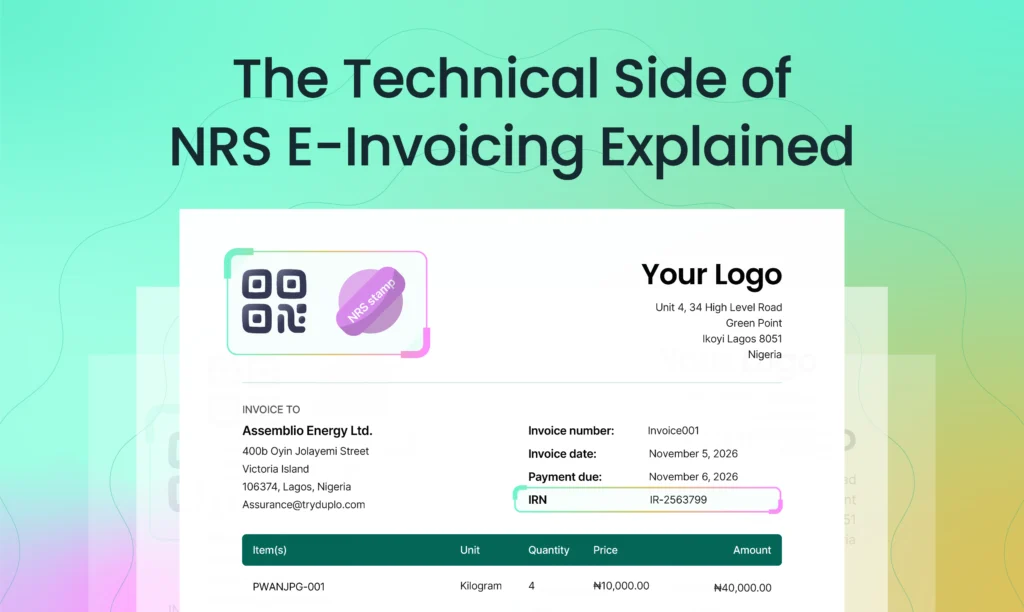
The Invoice Reference Number (IRN) is the unique identifier the NRS assigns to each validated invoice. It is generated by the MBS after the invoice has been submitted and verified.
An IRN serves several purposes:
- It proves the invoice has been seen and validated by the NRS
- It ties the invoice permanently to the NRS’s tax records
- It enables buyers to verify the invoice is genuine and compliant
- It makes the invoice eligible for input VAT recovery by the buyer
An invoice without an IRN is not a valid tax document under the NRS framework. It cannot be used to support VAT claims, and issuing one in place of a valid e-invoice carries the penalties we detailed in our previous blog.
The IRN is embedded in the invoice data and also encoded into the QR code that appears on every compliant NRS e-invoice.
What Is the QR Code and What Does It Contain?
Every NRS-compliant invoice must include a QR code. This is not a decorative element; it is a data-rich verification tool. When scanned, the QR code allows any party, be it the buyer, an auditor, or the NRS itself, to instantly verify:
- Whether the invoice exists in the NRS system
- That the seller’s TIN is valid and matches the invoice
- That the invoice amount and VAT have been correctly reported
- That the IRN is authentic and has not been tampered with
This is how the NRS can cross-check declared transactions with what is actually reported on the MBS platform in real time. It is also why submitting a manually altered or backdated invoice after the fact is not a viable workaround. The data is already locked in the system.
For printed or PDF versions of e-invoices, the QR code allows physical verification without needing to access any online system.
What Is UBL Format and Why Does It Matter?
Universal Business Language (UBL) is the international XML-based standard that the NRS requires for e-invoices. UBL is not a software product; it is a data structure standard that defines exactly what fields an invoice must contain, in what order, and in what format.
? This matters because it standardizes invoices across all businesses and systems, enabling the MBS to read and process invoices from thousands of different software environments. It’s the same reason PEPPOL (the global e-invoicing framework Nigeria has adopted elements of) works across different countries and software providers.
For your business, UBL compliance means your invoicing system, whether it’s an ERP like SAP or Microsoft Dynamics, or accounting software like QuickBooks or Sage, must be able to produce or export invoices in XML/UBL format. Many systems do not do this out of the box and require either an upgrade or a middleware integration.
How Does the Four-Corner PEPPOL Model Work?
Nigeria’s e-invoicing infrastructure borrows from the PEPPOL “four-corner” model:
Corner 1 — The Supplier:
Your business generates the e-invoice in UBL format
Corner 2 — Supplier’s Access Point:
Your accredited Access Point Provider (APP) receives the invoice, validates it against NRS rules, and transmits it to the NRS
Corner 3 — NRS / MBS:
The tax authority validates and stamps the invoice, generating the IRN and QR code
Corner 4 — The Buyer’s Access Point:
The stamped, validated invoice is delivered to the buyer through their access point
? In practice, many businesses, especially SMEs, will connect through a single service provider who acts as their Access Point, bridging Corners 2 and 4 simultaneously.
What Is an NRS e-Address?
An NRS e-address is a digital identifier assigned to each business registered on the MBS platform. It functions like an email address, but specifically for routing e-invoices through the NRS system. You need one to send or receive NRS-compliant invoices.
Getting an e-address is part of the NRS onboarding process, and it’s linked to your Tax Identification Number (TIN).
What Data Must an NRS E-Invoice Contain?
A fully compliant NRS e-invoice must include:
- Seller’s business name, address, and TIN
- Buyer’s name, address, and TIN (for B2B transactions)
- Invoice Reference Number (IRN)
- Invoice date and time of issuance
- A unique sequential invoice number
- Line-by-line description of goods or services
- Quantity, unit price, and total line amounts
- VAT rate and VAT amount per line
- Total invoice amount (including and excluding VAT)
- QR code (encoded with IRN and validation data)
- NRS digital stamp confirming pre-clearance
Missing any of these fields means the invoice fails validation at the MBS level and is returned without an IRN.
Why This Complexity Is Actually an Opportunity
While all of this might seem technically burdensome, there is a practical upside: businesses that implement NRS e-invoicing properly end up with cleaner books, faster payment cycles, and real-time financial data that most Nigerian businesses have never had access to before.
Countries that have implemented similar systems report that e-invoicing reduces invoice processing costs by up to 50%, accelerates payment timelines, and dramatically reduces errors and disputes between buyers and sellers.
So yes, the system is technical. But that’s by design.
Generate IRNs, QR Codes, and Validated Invoices Automatically with Duplo
Duplo handles every element of the NRS e-invoicing technical stack on your behalf. When you issue an invoice through Duplo, the system generates the UBL-format document, transmits it to the NRS, retrieves the IRN, embeds the QR code, and delivers the validated invoice to your buyer — automatically, in one workflow.
No XML coding. No NRS API configuration. No manual QR generation.
? Generate fully compliant NRS e-invoices automatically. Sign up on Duplo today